
In one sentence
Making a video game is unusually difficult because developers must coordinate creative work, interactive systems, changing technology, uncertain schedules, market demands, and corporate decision-making simultaneously. Completion is often an achievement of adaptation and endurance—not proof that the original plan worked.
Overview
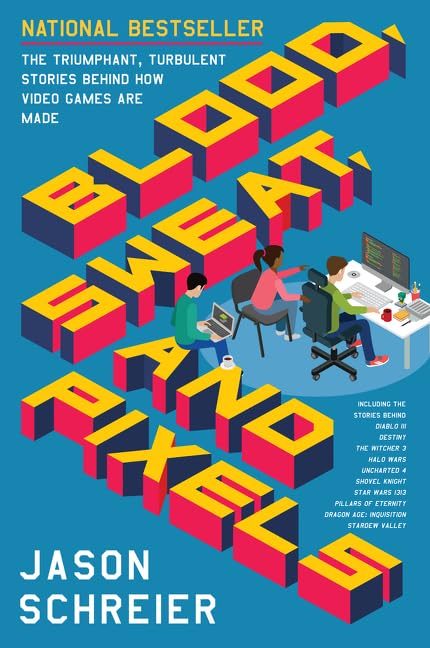
Schreier structures the book as ten case studies: Pillars of Eternity, Uncharted 4, Stardew Valley, Diablo III, Halo Wars, Dragon Age: Inquisition, Shovel Knight, Destiny, The Witcher 3, and the canceled Star Wars 1313. The contrast between them is central: a solo developer, a crowdfunded studio, established AAA teams, and a project that never shipped all encounter different versions of “development hell.”
Core ideas
Games are moving targets
Unlike a film, a game must respond to player actions while tracking systems, states, bugs, and narrative consequences. Developers are therefore building something whose behavior is partly discovered only through testing.
Technology changes during production
Teams frequently build on unfinished or unreliable tools and engines. Technical problems can force redesigns, invalidate months of work, or make a seemingly reasonable schedule meaningless; the process resembles laying track while the train is moving.
Schedules are estimates, not control systems
Creative iteration and unexpected technical work make game schedules fragile. When release dates remain fixed, the missing time is commonly extracted through overtime, cuts, rushed fixes, or reduced scope.
Scale changes the failure mode
Solo and small teams face limited money, labor, and redundancy; large teams face coordination costs, managerial layers, competing visions, and dependence on publishers. Neither scale is simply easier.
Crunch is presented as both practice and problem
Many stories rely on long hours and last-minute pushes. The book treats this as a recurring mechanism for shipping, but its case studies also expose the human costs: burnout, strained relationships, attrition, and studios that do not survive.
Success can conceal dysfunction
A well-reviewed or commercially successful game may still have been technically unfinished, painfully mismanaged, or damaging to its creators. A shipped product is not an audit showing that the production process was healthy.
Cancellation is part of the industry’s normal economics
The Star Wars 1313 chapter makes visible the large amount of creative labor that can disappear when ownership, strategy, or corporate priorities change. A project’s quality is not enough to guarantee its continuation.
The book’s recurring human motive
Despite the pressure, developers persist because they care about making something enjoyable and distinctive. That commitment explains the industry’s resilience, but it can also make workers more vulnerable to exploitation and self-sacrifice.
Practical takeaways
- Treat a project plan as a set of hypotheses: prototype the riskiest technical and design assumptions early.
- Track scope, dependencies, and staffing honestly; a fixed launch date plus expanding ambition usually means hidden quality or labor costs.
- Separate admiration for a finished game from approval of how it was made.
- When evaluating a team or project, ask who bears the cost of uncertainty—owners, managers, contractors, or individual developers.
- Use small-team stories as evidence for focus and iteration, not as proof that heroic solo labor is a sustainable model.
- Remember that post-launch success does not erase production damage; assess retention, health, and institutional learning as outcomes too.
Caveats and counterpoints
- The book is a selective narrative survey, not a representative statistical study of game development. Its ten projects skew toward notable, high-profile games and memorable crises.
- Because each chapter is a compact, self-contained story, the book can repeat the same patterns—crunch, rework, executive interference—and may not provide a full account of ordinary, less dramatic productions.
- Some criticism argues that the book’s entertaining, resilient tone can soften or normalize worker exploitation, especially when extraordinary overtime is framed as part of a heroic shipping story.
- The case studies end largely around release and immediate aftermath, so they offer less sustained analysis of long-term labor conditions, unionization, or how studios changed later.
Questions worth revisiting
- Which problems are intrinsic to interactive software, and which are created by publisher strategy or poor management?
- When does perseverance become avoidable self-exploitation?
- Would the same games have been possible with realistic schedules and less crunch—or would they have needed radically different scopes?
- Why do the small-team chapters often feel more coherent than the AAA accounts?
- What would a companion volume centered on failed, ordinary, or worker-led projects add to Schreier’s picture?
- How should consumers weigh a game’s artistic achievement against the conditions under which it was produced?
Return to this when…
Return to these notes when a game’s polished release makes its production seem inevitable, or when you need a compact reminder that creative ambition, technical uncertainty, organizational scale, and labor practices are inseparable in software projects.
References
- Blood, Sweat, and Pixels: The Triumphant, Turbulent Stories Behind How Video Games Are Made by Jason Schreier - Books on Google Play
- Review of Blood, Sweat, and Pixels: The Triumphant, Turbulent Stories Behind How Video-Games Are Made
- en.wikipedia.org
- goodreads.com
- Book Review: Blood, Sweat, and Pixels ~ Observational Hazard
- sobrief.com
- byanyothernerd.com
- shortform.com
- wbur.org
- Blood, Sweat, and Pixels: The Triumphant, Turbulent Stories Behind How Video Games Are Made by Jason Schreier | Goodreads
- reddit.com
- choicestgames.com
- si.edu