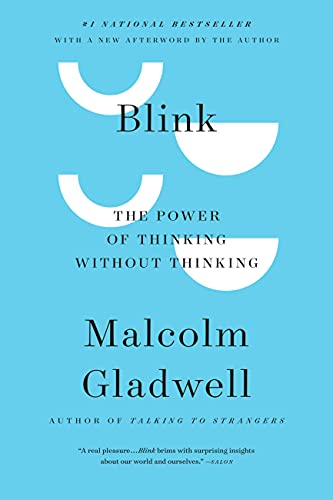

In one sentence
Fast judgments are not automatically irrational: the unconscious can detect meaningful patterns from very little information. But intuition is reliable only when it draws on relevant experience, has feedback, and operates in a stable environment. Deliberation is not always superior, yet neither is instinct something to trust indiscriminately.
Overview
Gladwell presents rapid cognition through a sequence of vivid case studies. The Getty kouros introduces the idea that experts may sense inauthenticity before they can explain why. Other chapters explore John Gottman’s brief observations of couples, the “Warren Harding error” in judging leadership by appearance, police encounters shaped by racial assumptions, Pepsi/Coke taste tests, and the Millennium Challenge war game. The recurring contrast is between useful unconscious pattern recognition and snap judgment corrupted by bias, overload, or context.
Core ideas
Thin-slicing
The mind can extract information from a narrow slice of behavior or evidence. This works best when the observer has developed relevant expertise and the available cues genuinely predict the outcome; it is not a general license to decide quickly.
Expert intuition is compressed learning
A skilled judgment may feel like a hunch because years of practice have made pattern recognition automatic. The speed is the visible part; accumulated experience and feedback are the hidden basis.
More information can make decisions worse
Additional facts do not necessarily improve judgment. They can create noise, encourage rationalization, or delay recognition of the few variables that matter. Gladwell’s examples favor disciplined attention over indiscriminate data collection.
The unconscious is both capable and biased
Rapid cognition can notice subtle patterns, but it also imports stereotypes and framing effects. The book’s discussion of race and policing shows that an immediate perception may feel personal and certain while being socially conditioned.
Context changes performance
Stress, time pressure, authority structures, and emotional arousal can alter what the mind notices. The Millennium Challenge example contrasts a flexible, decentralized approach with elaborate systems that became liabilities under the exercise’s conditions.
Intuition needs a domain
A useful practical distinction is between a judgment made in a familiar, feedback-rich setting and one made in a novel or politically loaded setting. The former may deserve provisional trust; the latter usually needs deliberate checks.
Practical takeaways
- Before trusting a hunch, ask: What experience produced it, and have I received accurate feedback in this kind of situation?
- Separate noticing from interpreting. Record the immediate impression, then identify which observable cues support it and which may reflect stereotype or halo effect.
- Reduce irrelevant information when the decision depends on a few validated signals—but do not confuse simplicity with accuracy.
- Use structured procedures or checklists for high-stakes decisions when intuition is vulnerable to bias, fatigue, emotion, or unequal power.
- Treat first impressions as hypotheses, not verdicts. Look for disconfirming evidence, especially when judging people.
- Protect decision quality by managing the setting: reduce unnecessary pressure, clarify the goal, and avoid letting status or appearance dominate attention.
Caveats and counterpoints
- Blink is narrative popular psychology, not a systematic review or a unified theory of judgment. Its memorable cases can make conclusions feel broader and more settled than the underlying evidence warrants.
- The book sometimes moves quickly between expert intuition, unconscious bias, aesthetic perception, and social judgment. These may involve different mechanisms and should not automatically be treated as one kind of “thinking without thinking.”
- Gladwell’s argument can be misread as “trust your gut.” The stronger version is conditional: intuition is most dependable when the environment is regular and the judgment has been trained through meaningful feedback.
- A contemporary reader should be cautious about generalizing from striking anecdotes. The book’s examples illustrate possibilities; they do not by themselves establish how often rapid judgments outperform deliberate analysis.
- Critics have noted a tension in the book’s advice: if a formula or structured process reliably improves a decision, the achievement may belong more to the procedure than to liberated intuition.
Questions worth revisiting
- Which of my fast judgments come from genuine expertise, and which come from familiarity, status cues, or stereotype?
- What kinds of decisions in my work or life have stable feedback loops—and which do not?
- When has gathering more information improved a decision, and when has it merely prolonged rationalization?
- What simple structure could test my first impression without eliminating useful expertise?
- How would the decision change if identifying information—name, appearance, prestige, or demographic cues—were temporarily hidden?
Return to this when…
Return to the sections on thin-slicing, the Warren Harding error, and bias when you need a compact reminder that intuition is neither magic nor noise: it is trained pattern recognition operating inside a social and emotional context.