
In one sentence
Cowen’s central claim is not that big business is virtuous or that corporations should escape scrutiny. It is that Americans judge business by vivid failures and scandals while overlooking its ordinary, cumulative contributions: useful products, rising living standards, jobs, innovation, coordination, and investment. The appropriate comparison is not between perfect corporations and imperfect alternatives, but between real businesses and the costs of replacing them.
Overview
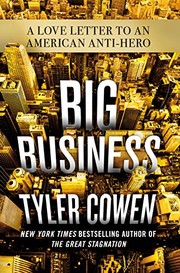
Published by St. Martin’s Press in 2019, the book is organized as a series of challenges to big business: honesty, CEO compensation, work, monopoly, Big Tech, health care, finance, and cronyism. Cowen’s method is comparative and utilitarian: ask whether corporations perform better than individuals, government, nonprofits, or smaller firms, and count benefits that are dispersed and easy to take for granted. The publisher’s contents and contemporary reviews identify this sequence of arguments; the book is a polemic rather than a comprehensive theory of corporate governance.
Core ideas
Use the right counterfactual
A corporation should not be evaluated only against an idealized ethical standard. Cowen repeatedly asks whether the relevant alternative—government administration, informal exchange, small firms, or no service at all—would perform better. This reframes criticism from “Does business cause harm?” to “What arrangement produces less harm and more value?”
Business is a trust-producing institution
People often say they distrust corporations, yet routinely buy products, use infrastructure, accept employment, and rely on firms to deliver what was promised. Cowen interprets this behavior as evidence that practical trust is higher than survey attitudes suggest. The insight is useful, but it does not eliminate concerns about unequal bargaining power or dependence.
Large scale can be productive, not merely predatory
Size can lower costs, spread fixed investments, coordinate complex supply chains, support research, and make specialized goods widely available. Cowen argues that concentration is not automatically monopoly: a large firm may face competition from substitutes, potential entrants, foreign firms, or changing technology.
The market test is informative but incomplete
Consumer willingness to pay is evidence that a product creates value, but it is not a complete moral or social test. Prices may omit pollution, privacy loss, labor harms, political influence, or risks borne by people who are not customers. Cowen’s framework is strongest when used as one test among several.
Big Tech’s benefits complicate condemnation
Search, mapping, communication, platforms, and digital services produce large consumer benefits, often at low monetary prices. Cowen accepts that privacy and platform power are genuine problems but argues that critics frequently treat those costs as if they cancel out the services’ broad usefulness. His defense is consequentialist, not a claim that technology firms are harmless.
Finance is infrastructure for production
Cowen presents finance as a mechanism for allocating capital, sharing risk, funding innovation, and coordinating investment—not merely as speculative extraction. The implication is that hostility toward finance can obscure how much ordinary prosperity depends on financial intermediation. This argument requires distinguishing productive finance from crises, rent-seeking, and institutions protected by implicit guarantees.
Work has value beyond wages
The workplace supplies structure, social contact, identity, status, and purpose as well as income. Cowen therefore resists treating employment simply as an unpleasant necessity imposed by employers. The limitation is that the meaningfulness of work varies sharply with autonomy, security, pay, management quality, and the worker’s alternatives.
Criticism should be comparative and balanced
Cowen often grants that corporate misconduct exists—especially in health care, privacy, sexual harassment, and some business practices—then asks whether the criticism fairly compares those harms with the benefits corporations generate. Reviewers note that this makes the book more balanced than a simple defense, though some also find its reframing too lawyerly or forgiving.
Practical takeaways
- When evaluating a corporation, list both visible harms and dispersed benefits before reaching a conclusion.
- Ask what the realistic replacement would be, not whether the firm falls short of perfection.
- Separate firm size from monopoly power; investigate entry barriers, substitutes, switching costs, and political protection.
- Treat consumer choice as evidence of value, not proof that all effects are socially beneficial.
- Distinguish productive financial intermediation from leverage, fraud, bailouts, and rent extraction.
- For workplace debates, assess autonomy, dignity, safety, pay, flexibility, and social connection—not wages alone.
- Use Cowen as an antidote to reflexive anti-business thinking, not as a substitute for antitrust, privacy, labor, or consumer-protection analysis.
Caveats and counterpoints
- The book’s burden of proof is asymmetrical: Cowen emphasizes aggregate gains and often treats harms as correctable exceptions, which can understate distributional consequences and political power.
- Its defense of concentration is contestable. A firm may provide cheap or excellent services while still reducing competition, extracting data, suppressing wages, or influencing regulation.
- The claim that corporations are no more deceptive than other actors does not settle whether corporations possess unusual scale, resources, or capacity to make harms systemic.
- Cowen’s discussion of health-care consolidation, privacy, and sexual harassment reportedly acknowledges serious problems but sometimes attributes them partly to regulation or emphasizes subsequent improvement; skeptical readers may regard these responses as insufficiently institutional.
- The book appeared in April 2019, before later developments in generative AI, platform regulation, pandemic supply-chain shocks, and newer antitrust cases. Its framework may still apply, but its examples and empirical premises should not be treated as current.
- Reception reflects the book’s polarizing design: sympathetic reviewers praised its evidence-based reframing, while Kirkus judged it unlikely to change the minds of readers already skeptical of big business.
Questions worth revisiting
- Which benefits of big business are genuinely scale-dependent, and which could be supplied by competitive smaller firms?
- When does a corporation’s political influence become a form of cronyism rather than ordinary advocacy?
- How should privacy, worker power, environmental damage, and inequality be valued against consumer surplus?
- Does a market test remain reliable when products are addictive, defaults are manipulative, or alternatives are unavailable?
- What institutional reforms would preserve corporate innovation while limiting monopoly, exploitation, and systemic risk?
Return to this when…
Return to this book when anti-corporate arguments feel too easy, or when pro-business arguments seem to ignore real harms. Its most durable use is as a checklist for identifying neglected benefits and examining counterfactuals; pair it with work on concentration, labor power, privacy, externalities, and corporate political influence for a fuller assessment.