
In one sentence
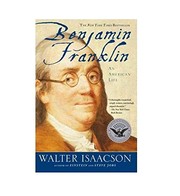
Franklin’s significance lies not merely in his inventions or diplomatic achievements, but in how he modeled—and helped construct—an emerging American character: practical, self-improving, commercially minded, intellectually curious, socially networked, and committed to public usefulness. Isaacson treats this identity as productive but morally and personally conflicted.
Overview
The biography follows Franklin from Boston apprenticeship and his escape to Philadelphia, through his rise as a printer and publisher, scientific investigations, civic projects, colonial politics, diplomatic missions in London and Paris, the Revolution, constitution-making, and his final years. Its narrative combines public achievement with relationships, especially Franklin’s strained family life and political disagreements.
Core ideas
Self-making is both genuine and staged
Franklin deliberately fashioned himself as evidence that disciplined effort, literacy, frugality, and useful enterprise could produce social mobility. His public image was not simply vanity: it was also a persuasive prototype for a new, meritocratic society.
Public improvement through voluntary association
Franklin repeatedly turned curiosity into institutions: publishing ventures, scientific communities, libraries, educational projects, fire protection, and other civic arrangements. The pattern is practical rather than grandiose—identify a shared problem, organize people, and build a durable mechanism.
Science as inquiry, not ornament
Isaacson emphasizes Franklin as a serious experimental thinker, especially in electricity and atmospheric phenomena. Franklin’s importance is not only that he discovered or invented things, but that he connected observation, explanation, experiment, and public communication.
Politics as coalition-building
Franklin’s political strength came from mediation, persuasion, and social intelligence. His views changed over time, and Isaacson presents those shifts as part of his responsiveness to circumstances rather than as a single rigid ideology.
The American middle-class outlook
The book links Franklin to a distinctly American blend: individual self-reliance, confidence in ordinary citizens, commercial ambition, and concern for community projects. This combination is liberal in public purpose, conservative in its emphasis on independence, and populist in its distrust of entrenched elites.
The legend has serious fractures
Franklin’s sociability and public charm coexisted with emotional distance from his family. He missed important family events and was absent at his wife’s death; his relationship with his Loyalist son also reveals how political commitments could override domestic bonds.
Moral progress does not erase earlier complicity
Franklin published advertisements for slave sales and at times owned enslaved people, yet later became an advocate for abolition. Isaacson presents this evolution as real but does not make the later position a clean excuse for the earlier record.
Practical takeaways
- Convert curiosity into experiments, records, and explanations that other people can use.
- Treat reputation as something shaped through repeated public behavior—but remember that a successful public persona may conceal private costs.
- Build institutions, not just opinions: durable civic improvements usually require coordination and maintenance.
- Use networks for shared purposes rather than treating networking as self-promotion alone.
- Expect political judgment to require compromise, revision, and coalition-building.
- Separate achievement from virtue: exceptional usefulness does not guarantee emotional reliability or moral consistency.
Caveats and counterpoints
- This is a sympathetic, highly readable biography, and some reviewers regard its length and detail as excessive for readers seeking a shorter introduction.
- Isaacson’s emphasis on Franklin as a prototype of modern American enterprise can make the biography feel especially relevant to contemporary professional culture; that framing may understate aspects of colonial society that do not fit the entrepreneurial narrative.
- Franklin’s later antislavery position matters, but it should be read alongside his earlier participation in and benefit from slavery rather than as a complete moral resolution.
- The account of Franklin’s private life is necessarily mediated by surviving correspondence, autobiography, family recollections, and later interpretation; public Franklin is better documented than intimate Franklin.
Questions worth revisiting
- Which parts of Franklin’s self-made image were earned, and which were carefully manufactured?
- Can civic usefulness compensate for failures of family responsibility?
- When does political flexibility become opportunism, and when is it necessary prudence?
- Does Franklin’s scientific method offer a better model for public reasoning than his political rhetoric?
- How should a later moral change affect our judgment of earlier participation in injustice?
- Which elements of Franklin’s middle-class ideal remain valuable, and which now seem exclusionary or incomplete?
Return to this when…
Return to the notes when thinking about self-invention, civic institutions, scientific curiosity, coalition politics, or the gap between public achievement and private character. Pair with Franklin’s Autobiography for his own carefully constructed account, and with a more critical study if you want greater emphasis on slavery, race, family conflict, or the limits of the American self-made ideal.
Highlights
Frugality became for him not only a virtue but also a pleasure. “Industry and frugality,” he wrote in describing the theme of Poor Richard’s almanacs, are “the means of procuring wealth and thereby securing virtue.”
Just the opposite. A tale related by his grandson, but not included in the autobiography, shows Franklin to be cheeky not only about religion but also about the wordiness in worship that was a hallmark of Puritan faith. “Dr. Franklin, when a child, found the long graces used by his father before and after meals very tedious,” his grandson reported. “One day after the winter’s provisions had been salted—‘I think, Father,’ said Benjamin, ‘if you were to say Grace over the whole cask—once for all—it would be a vast saving of time.’
Throughout his life, he would occasionally make enemies, such as the Penn family, and jealous rivals, such as John Adams. But he did so less than most men, especially men so accomplished. A secret to being more revered than resented, he learned, was to display (at least when he could muster the discipline) a self-deprecating humor, unpretentious demeanor, and unaggressive style in conversation.
To perfect the art of becoming such a reliable person, Franklin wrote out a “Plan for Future Conduct” during his eleven-week voyage back to Philadelphia. It would be the first of many personal credos that laid out pragmatic rules for success and made him the patron saint of self-improvement guides. He lamented that because he had never outlined a design for how he should conduct himself, his life so far had been somewhat confused. “Let me, therefore, make some resolutions, and some form of action, that, henceforth, I may live in all respects like a rational creature.” There were four rules: It is necessary for me to be extremely frugal for some time, till I have paid what I owe. To endeavor to speak truth in every instance; to give nobody expectations that are not likely to be answered, but aim at sincerity in every word and action—the most amiable excellence in a rational being. To apply myself industriously to whatever business I take in hand, and not divert my mind from my business by any foolish project of suddenly growing rich; for industry and patience are the surest means of plenty. I resolve to speak ill of no man whatever.
One night, just as he was finishing that day’s sheet, the plate dropped and broke; Franklin stayed overnight to redo it. “This industry visible to our neighbors began to give us character and credit,” Franklin noted. One of the town’s prominent merchants told members of his club, “The industry of that Franklin is superior to anything I ever saw of the kind; I see him still at work when I go home from club, and he is at work again before his neighbors are out of bed.” Franklin became an apostle of being—and, just as important, of appearing to be—industrious. Even after he became successful, he made a show of personally carting the rolls of paper he bought in a wheelbarrow down the street to his shop, rather than having a hired hand do it.
The tone Franklin set for Junto meetings was earnest. Initiates were required to stand, lay their hand on their breast, and answer properly four questions: Do you have disrespect for any current member? Do you love mankind in general regardless of religion or profession? Do you feel people should ever be punished because of their opinions or mode of worship? Do you love and pursue truth for its own sake?
Franklin was worried that his fondness for conversation and eagerness to impress made him prone to “prattling, punning and joking, which only made me acceptable to trifling company.” Knowledge, he realized, “was obtained rather by the use of the ear than of the tongue.” So in the Junto, he began to work on his use of silence and gentle dialogue.
The other sins on his list were, in order: seeming uninterested, speaking too much about your own life, prying for personal secrets (“an unpardonable rudeness”), telling long and pointless stories (“old folks are most subject to this error, which is one chief reason their company is so often shunned”), contradicting or disputing someone directly, ridiculing or railing against things except in small witty doses (“it’s like salt, a little of which in some cases gives relish, but if thrown on by handfuls spoils all”), and spreading scandal (though he would later write lighthearted defenses of gossip).
- Have you met with anything in the author you last read remarkable or suited to be communicated to the Junto?… 2. What new story have you lately heard agreeable for telling in conversation? 3. Hath any citizen in your knowledge failed in his business lately, and what have you heard of the cause? 4. Have you lately heard of any citizen’s thriving well, and by what means? 5. Have you lately heard how any present rich man, here or elsewhere, got his estate? 6. Do you know of any fellow citizen who has lately done a worthy action deserving praise and imitation? Or who has committed an error proper for us to be warned against and avoid? 7. What unhappy effects of intemperance have you lately observed or heard? Of imprudence? Of passion? Or of any other vice or folly?… 12. Hath any deserving stranger arrived in town since last meeting that you heard of? And what have you heard of his character or merits? And whether you think it lies in the power of the Junto to oblige him or encourage him as he deserves?… 14. Have you lately observed any defect in the laws of your country of which it would be proper to move the legislature for an amendment? 15. Have you lately observed any encroachments on the just liberties of the people? 16. Has anybody attacked your reputation lately, and what can the Junto do toward securing it? 17. Is there any man whose friendship you want and which the Junto or any of them can procure for you?… 20. In what manner can the Junto or any of them assist you in any of your honorable designs?
In his first letter to his readers, he announced that “there are many who have long desired to see a good newspaper in Pennsylvania,” thus taking a poke at both Keimer and Bradford.
In his effort to decide whether he should take the customer’s money even though it violated his principles, Franklin subjected himself to the following test: To determine whether I should publish it or not, I went home in the evening, purchased a twopenny loaf at the baker’s, and with the water from the pump made my supper; I then wrapped myself up in my great-coat, and laid down on the floor and slept till morning, when, on another loaf and a mug of water, I made my breakfast. From this regimen I feel no inconvenience whatever. Finding I can live in this manner, I have formed a determination never to prostitute my press to the purposes of corruption and abuse of this kind for the sake of gaining a more comfortable subsistence.
One day, Andrews prevailed on him to sample his Sunday sermons, which Franklin did for five weeks. Unfortunately, he found them “uninteresting and unedifying since not a single moral principle was inculcated or enforced, their aim seeming to be rather to make us good Presbyterians than good citizens.” On his final visit, the reading from the Scripture (Philippians 4:8) related to virtue. It was a topic dear to Franklin’s heart, and he hoped that Andrews would expound on the concept in his sermon. Instead, the minister focused only on dogma and doctrine, without offering any practical thoughts about virtue. Franklin was “disgusted,” and he reverted to spending his Sundays reading and writing on his own.
Poor Richard went on to predict “the inexorable death” of his rival Titan Leeds, giving the exact day and hour. It was a prank borrowed from Jonathan Swift. Leeds fell into the trap, and in his own almanac for 1734 (written after the date of his predicted death) called Franklin a “conceited scribbler” who had “manifested himself a fool and a liar.” Franklin, with his own printing press, had the luxury of reading Leeds before he published his own 1734 edition. In it, Poor Richard responded that all of these defamatory protestations indicate that the real Leeds must indeed be dead and his new almanac a hoax by someone else. “Mr. Leeds was too well bred to use any man so indecently and scurrilously, and moreover his esteem and affection for me was extraordinary.”
“He that has once done you a kindness will be more ready to do you another, than he whom you yourself have obliged.”
References
- Benjamin Franklin: An American Life Themes | SuperSummary
- Benjamin Franklin: An American Life | Foreign Affairs
- books.google.com
- BENJAMIN FRANKLIN by Walter Isaacson | Kirkus Reviews
- Benjamin Franklin: An American Life - Walter Isaacson - Google Books
- books.google.com
- en.wikipedia.org
- BENJAMIN FRANKLIN | Kirkus Reviews
- publishersweekly.com
- Benjamin Franklin | Book by Walter Isaacson | Official Publisher Page | Simon & Schuster
- simonandschuster.com
- supersummary.com