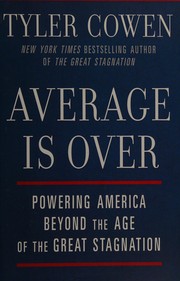

In one sentence
“Average” is losing its economic security. Intelligent machines, globalization, and data-driven evaluation increasingly reward people who can work effectively with technology, while reducing the value of routine labor. Growth may continue, but its gains will be distributed unevenly, producing a hyper-meritocratic economy rather than a revived middle class.
Overview
Cowen’s follow-up to The Great Stagnation explains why economic expansion can coexist with stagnant median wages and widening inequality. His central image is a labor market split between high performers who use machines to multiply their capabilities and workers pushed toward lower-paid personal-service jobs. He extends the argument to education, health care, government spending, cities, family life, and the future of economics.
Core ideas
Human-machine complementarity beats human-versus-machine thinking
The most valuable workers are not necessarily those who outperform computers unaided. They are people who know how to frame problems, interpret outputs, exercise judgment, coordinate teams, and use software to achieve results that neither person nor machine could produce alone. Cowen uses “freestyle chess”—human-computer teams—as his recurring model.
The labor market polarizes
Automation removes or cheapens many routine tasks, especially where rules can be formalized. At the top, technology raises the productivity and reach of already effective workers; at the bottom, jobs remain where human presence, dexterity, trust, or personal interaction are difficult to automate. The result is more opportunity at both extremes and less stability in the middle.
Performance becomes more measurable
As organizations collect more data, workers and institutions can be evaluated against increasingly precise benchmarks. This favors conscientiousness, adaptability, teamwork, and a willingness to learn from feedback—not merely credentials or traditional professional status. Cowen expects computers to take over more analysis while humans specialize in interpreting and applying results.
Education must become more individualized
A single standardized educational pathway is poorly suited to a world with sharply different abilities and labor-market outcomes. Cowen anticipates more technology-assisted learning, stronger sorting by demonstrated performance, and teachers becoming curators, motivators, and organizers rather than merely transmitters of information.
Place matters more than the national average
Cowen expects cities and regions to diverge. Locations with cheap housing, expanding employment, business formation, and tolerable public services may attract people and firms even without elite amenities. He points to Texas as an example of this development model, though critics argue that his treatment understates political and social backlash.
Policy will adapt to inequality rather than eliminate it
Cowen sketches a future in which taxes on high earners may rise while public benefits become more selective, health-care costs remain burdensome, and consumption shifts away from wasteful goods. He does not present redistribution as a complete solution; his emphasis is on adapting institutions to persistent technological inequality.
Practical takeaways
- Learn to use important tools in your field rather than treating technology as a separate specialty.
- Develop complementary skills: problem selection, communication, judgment, coordination, taste, and accountability.
- Seek work where your contribution is difficult to reduce to a repeatable procedure or easily measured routine.
- Treat credentials as an entry signal, not as a durable substitute for demonstrated performance.
- Expect continuous evaluation and build a habit of using feedback and data to improve.
- When assessing a region or career, look beyond averages: examine housing costs, job creation, institutional quality, and the local concentration of opportunity.
Caveats and counterpoints
- The book is a forecast from 2013, not a current account of artificial intelligence or labor markets; its examples and timing should not be treated as up-to-date predictions.
- Cowen’s core mechanism—technology rewarding complements and replacing routine work—is clearer than his quantitative support. Publishers Weekly criticized the book as speculative and overly dependent on computerized-chess analogies, while Kirkus likewise noted that it too readily dismisses the possibility of serious social unrest.
- The argument can sound more deterministic than the evidence warrants: institutions, unions, education systems, immigration, ownership of technology, and public policy can influence who receives the gains.
- “Hyper-meritocracy” may conceal unequal starting points. Access to good schools, networks, health, stability, and technology affects who can become an effective machine complement.
- The book’s optimistic claim that cheaper goods and new opportunities may offset inequality is contested; critics argue that lower prices do not automatically replace lost status, bargaining power, or secure employment.
Questions worth revisiting
- Which parts of Cowen’s forecast depend on technology, and which depend on policy choices about ownership, education, and redistribution?
- Are the skills he calls complementary genuinely scarce, or can software eventually automate much of judgment and coordination too?
- Does a service-heavy economy provide enough income, dignity, and mobility for workers displaced from routine middle-class jobs?
- What would count as evidence that the middle is recovering rather than merely being redefined?
- How should the freestyle-chess analogy be limited when real workplaces involve power, institutions, tacit knowledge, and unequal access to tools?
Return to this when…
Return to this book when evaluating claims that automation will either destroy all jobs or benefit everyone equally. Its most useful lens is the distinction between tasks technology replaces and capabilities technology amplifies; its weakest point is the confidence of its longer-range social and policy forecasts.
Highlights
There is now a joke that “a modern textile mill employs only a man and a dog—the man to feed the dog, and the dog to keep the man away from the machines.”
To put the question in the bluntest possible way, let’s say that machine intelligence helps us make a lot more things more cheaply, as indeed it is doing. Where will most of the benefits go? In accord with economic reasoning, they will go to that which is scarce. In today’s global economy here is what is scarce: 1. Quality land and natural resources 2. Intellectual property, or good ideas about what should be produced 3. Quality labor with unique skills Here is what is not scarce these days: 1. Unskilled labor, as more countries join the global economy 2. Money in the bank or held in government securities, which you can think of as simple capital, not attached to any special ownership rights (we know there is a lot of it because it has been earning zero or negative real rates of return)
Labor markets are tough, and not always fair, but intelligence will be rewarded for a long time to come. So will the right skills in STEM fields, finance, management, and marketing, all of which meld together the strengths of diverse intelligences, whether those intelligences are human or not.
Male wages have done starkly worse than median household income. As we all know, women in American labor markets have become more educated, more ambitious, and they have faced less discrimination, all to the better. Women have made some unique, one-time economic gains through these social advances. But for men, from 1969 to 2009, as measured, it appears that wages for the typical or median male earner have fallen by about 28 percent. I’ve seen attempts to dispute these numbers, but the result remains embarrassing; Brookings Institution researcher Scott Winship, for instance, argues that since 1969 the truth is that male wages have fallen by “only” 9 percent. That’s still a dismal record.
The financial crash was a very bad one-time event that revealed, rather suddenly, this more fundamental long-term structural problem, namely that a lot of workers had been overemployed relative to their skills.
After the first quarter of 2009, per-labor-hour productivity rose dramatically. Why did that happen? Was it because we invented workable nanotechnology or some fantastic new and highly productive machine in April of 2009? I don’t think so. It’s because we laid off a lot of workers who weren’t producing enough for their level of pay. Bosses were pulling the less productive workers out of the higher-paying jobs. And afterward they didn’t want most of them back. That caused average productivity to rise.
How good is private use of Google as a diagnostic device? We still don’t know. How many home users know they might get a better set of results with a search procedure like “‘Metabolic Syndrome’ site:edu”? Probably not so many.
What does all this mean for our decisions, especially in the workplace? 1. Human strengths and weaknesses are surprisingly regular and predictable. 2. Be skeptical of the elegant and intuitive theory. 3. It’s harder to get outside your own head than you think. 4. Revel in messiness. 5. We can learn.
References
- AVERAGE IS OVER | Kirkus Reviews
- Average Is Over: Powering America Beyond the Age of the Great Stagnation - Tyler Cowen - Google Books
- kirkusreviews.com
- Average is Over: Powering America Beyond the Age of the Great Stagnation - Tyler Cowen - Google Books
- goodreads.com
- Average Is Over: Powering America Beyond the Age of the Great Stagnation by Tyler Cowen
- investing.com
- functionallymad.com
- brookings.edu
- tylercowen.com
- sobrief.com
- commoncog.com