
In one sentence
Iwata’s central leadership idea is that sustainable success comes from understanding people—players, colleagues, and collaborators—then aligning them around an enjoyable, clearly defined purpose. Technical skill and business authority matter, but curiosity, empathy, direct communication, and the ability to remove obstacles matter just as much.
Overview
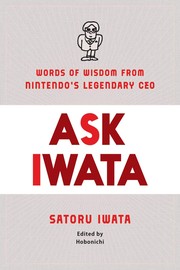
The book is a curated, translated selection rather than a continuous autobiography. It draws on “Iwata Asks” interviews with Nintendo developers and includes conversations involving Shigeru Miyamoto and Shigesato Itoi. Its material is organized around Iwata’s working philosophy, selected “words of wisdom,” and personal recollections after his death.
Core ideas
Find the bottleneck, not the scapegoat
When progress stalls, diagnose the specific constraint—technical, organizational, or communicative—rather than broadly blaming a team. Iwata’s programmer’s mindset favors making the problem concrete, then solving the narrowest obstruction first. The model is useful in projects where a few hidden constraints dominate the outcome.
Translate between specialties
Iwata treats development as a collaboration among people with different vocabularies and incentives. A leader’s job is not to be the smartest specialist in every room, but to help specialists understand one another well enough to make coherent decisions.
Protect curiosity from success
Past success can create resistance to change: established products, habits, and internal assumptions begin to feel safer than experimentation. Iwata’s implied corrective is to preserve beginner-minded questions—especially who the product is for and what problem it should solve—before optimizing familiar formulas.
Start with the human experience
The book repeatedly connects Nintendo’s design and business thinking to the experience of play: accessibility, shared enjoyment, surprise, and communication. Technology is valuable insofar as it enables a compelling experience for more people, not merely because it is technically impressive.
Use conversation as a management tool
Iwata’s interview style models leadership through questions: draw out how people think, let contributors explain their work, and make invisible effort visible. This supports trust and learning, though it requires time and genuine attention rather than scripted “listening.”
Treat programmers as problem-solvers
The book presents programming as a creative discipline capable of reframing problems, not merely implementing instructions. The advice that programmers should not reflexively say no is best read as encouragement to investigate alternatives before rejecting an ambitious request—not as permission to ignore constraints.
A leader can be both accountable and approachable
Iwata’s example combines executive responsibility with visible humility and continued identification as a developer and gamer. That combination helped him communicate across organizational levels, but the book’s admiring tone may understate the difficult trade-offs and institutional limits behind this idealized image.
Practical takeaways
- When a project is stuck, ask: “What is the one constraint currently limiting progress?” Test that diagnosis before adding people, meetings, or features.
- Explain the purpose of a project in user terms before debating implementation. Return to that purpose when specialists disagree.
- Interview collaborators about how they made a decision, not only whether the decision succeeded. This surfaces reusable reasoning.
- After a success, identify which assumptions the success may have made invisible. Deliberately seek evidence that the next situation is different.
- When rejecting an idea, separate “impossible,” “too costly,” “unsafe,” and “not worth doing.” Each calls for a different response.
- Keep a programmer’s habit of reducing vague problems to smaller, testable ones—even when working in management, strategy, or creative direction.
Caveats and counterpoints
- This is not a comprehensive history of Nintendo, Iwata’s career, or the development of the DS, Wii, Pokémon GO, or Switch; the publisher frames it as a motivational and philosophical collection.
- Because much of the book comes from interviews and retrospective tributes, it offers curated self-presentation and affectionate interpretation rather than independent evaluation of Iwata’s decisions.
- Some principles are highly context-dependent. Frequent personal conversations, broad experimentation, and people-first consensus can be expensive or slow in crisis situations, highly regulated environments, or teams with unclear authority.
- The advice is strongest for creative, technical, and collaborative work; it is less specific about finance, competitive strategy, performance management, and the measurable costs of Nintendo’s choices.
Questions worth revisiting
- Where is the current bottleneck in my work—and what evidence shows that it is the bottleneck?
- Which of my team’s disagreements are really translation problems between specialties?
- What success-based assumption am I protecting from challenge?
- Am I asking questions to learn, or merely to make people feel heard?
- When I say an idea will not work, which kind of “no” do I actually mean?
- How can I preserve the user’s experience as the reference point when technical or organizational pressures dominate?
Return to this when…
Return when leading a creative or technical project that feels divided, overcomplicated, or too attached to past success. The most useful sections are the ones on bottlenecks, communication across specialties, resistance to change, and the relationship between technical work and human experience. For a rigorous account of Nintendo’s strategy or Iwata’s full career, pair it with an independent biography or company history.
Highlights
When the going gets tough, if we’re not praised accordingly for our efforts, it makes things even harder. When things enter a downward spiral, people’s spirits flag all around, and speaking with staff becomes essential. Conversely, when the company is praised out of proportion for its efforts, it starts to feel like everyone can breathe more easily and relax.
To reiterate, I firmly believe in the importance of setting goals, even when the goals are without precedent. If you simply keep piling on features, one after the next, things get crowded and the end result is bulky. But if you have a clear vision for what you want, you can say “Let’s do it this way” and work your way backward from there. Granted, a president can’t just say “Let’s do it this way” once and expect everybody to share their vision. People need to hear the same thing over and over, but before long, something that you’ve said will stick. They’ll realize, “Oh, that’s what they mean.” One person will get the gist, and then two more, and so on, until everybody realizes: “Nintendo set this as a goal. That’s why we’re here.” That way everyone can share the same vision for the foreseeable future. Of course, this may mean sounding like a broken record for a while.
Even when your company is on top, you need to be ready to shake things up. When you have the greatest market share, you cannot lead the company in the same way as you would otherwise. But shaking things up is not enough. If you sense danger but you don’t switch direction, things will speed up and spin out of control, which means you can’t react too casually or you’ll lose your chance. So, if I felt like the company was heading nowhere despite being on top, I think I’d change course drastically, to the point where people might even protest, saying, “We were on top. Why’d you have to do that? Why not play it by ear?” Sometimes, though, a totally different approach is unavoidable.
The bigger an organization, the more important it is to decide, “All right! We’re focusing on this now.” Any company will have an endless list of pressing tasks, so if someone doesn’t provide direction, the firm will gradually lose potency. That’s why somebody like me, or Miyamoto, needs to step up to the plate and say, “Let’s give this a try.”
I’m always asking Itoi, “How did you know half a year out that this would be so popular?” Without fail, Itoi answers the same way: “I don’t predict the future. I simply notice the world starting to change a little before everybody else.” The first time I heard him say this, it made me wonder what it would take for me to be able to do this, too.
What games and other activities have in common is our initial approach. At first, we give them all our energy. That could mean time, labor, or money. Once we’ve done our best, we have a response to what we’ve done, and whatever feeling we experience is our reward. When the reward feels like it’s greater than the energy and effort we’ve expended, we don’t give up. But when the result of all our efforts is a disappointment, we tend to fail.
If you force yourself to study things that have no bearing on the world around you, the material will have no way of sinking in. So, rather than waste your time, it makes far more sense to prioritize the things that you truly enjoy, whatever speaks to you.
Miyamoto rates his level of accomplishment as a game designer on these terms, believing that if a customer fails to understand what to do, he has failed. Simply put, it’s all about the customer’s point of view, and Miyamoto has a way of getting there extremely early in the process. Meanwhile, I was mostly interested in how cool my programs were but had failed to consider how actual players might receive them. Lots of designers talk like I did back in the day, saying things like “Well, I think this is pretty cool,” speaking on behalf of the entire gaming population. What’s really needed is to address the reality of how players react, and ask the question “Why is that?” and finally “What can we do to get to the root of the problem?” But all too often people say, “I see it differently!” They hopelessly confuse theory and reality and force their opinions on others.
Looking back, it’s almost like we were in school—a school of management. What is “fun”? What is “software”? What does Nintendo value as a company? What should Nintendo strive to do, and to avoid? Yamauchi used to tell us, “If Nintendo tries to fight, it’s gonna lose. Don’t waste your energy on fighting.” In today’s business parlance, this translates into the idea of “blue ocean strategies.” Hiroshi Yamauchi realized at a very early date that when you’re creating a new piece of hardware, if all it does is repackage the same old gaming experience, it won’t actually feel new, and the gaming population won’t expand. It doesn’t matter if it’s a handheld console or a home console. If you make the same old thing, it won’t have character. And if it lacks character, all you do is add to the competition.
One of the most interesting things about the way Miyamoto forms ideas is how he works from functionality. Rather than arbitrarily adding characters to a story, he starts off with a functional premise such as “This will be boring unless there’s someone here.” This mode of thinking suggests the mind of somebody well versed in industrial design. As one example, Miyamoto’s idea, way back when, to have Mario ride on Yoshi’s back in Super Mario World sprang from a place of functionality. To be specific, the Super Famicom system did not allow for us to display a large number of sprites (a technical method for displaying graphical objects on the screen) in a row. Yoshi is shaped the way he is in order to limit the number of sprites in a row when Mario is riding him. If you look at the diagrams for Yoshi, it’s easy to see that he was designed purely from a place of functionality. We made Yoshi a dinosaur not because we wanted Mario to ride a dinosaur, but because the space we had, in terms of functionality, was shaped much like a dinosaur.
One way of defining a genius is “a person who can endlessly continue doing things that other people might dislike or easily grow tired of and be unable to continue.” I think that’s what we mean when we say “genius”—not giving up on your ideas, letting them have all the space they need. It may be exhausting, or it may perhaps be rewarding, but in any case it certainly isn’t easy. For a person who can do these things, however, it also isn’t torture. Those who think of it as torture will never surpass those who don’t see it as torture. That’s the essence of genius. Those who can persevere without thinking that they’re suffering, and thereby discover valuable things, are able to derive happiness from that alone.
Nobody can say for sure when to make a change. When Nintendo takes a different tack, there’s no telling whether it will take one year, or two, or three, or even five for people to catch on. But staying the course means not having a future. If you maintain the status quo, you wind up fighting for survival, and gradually your fan base disappears. That’s the one direction I’m always trying to avoid.
When you’re making a game, at first there are so many things you want to do, but piling on all the features you want won’t make the game superior. When you figure out exactly “what is necessary for this game,” a world of possibilities will open up. So, rather than tossing in whatever you want, it’s good to remember the creative power of paring back.
Sometimes in a game, you’ll find a stone just sitting there for no reason. Ask whoever made it “Why did you put this here?” and they’re liable to say “Why not?” But “why not” is the worst reason imaginable.
Another thing that I remember Iwata saying is “Anything a computer can do for you should be left to a computer.” Maybe this is obvious to people who can leverage computers on a daily basis, but to me it was a revelation. Iwata often said, “People only want to do things only people can do,” and I think that he was exactly right. Iwata was probably better at using computers than anyone, but he never used his expertise to set himself above others. Instead, I got the sense that he was interested mostly in the things that only human beings can do because of all the work computers could take off their hands.
References
- Ask Iwata: Words of Wisdom from Satoru Iwata, Nintendo's Legendary CEO - Hobonichi - Google Books
- Ask Iwata | Book by Hobonichi | Official Publisher Page | Simon & Schuster
- Ask Iwata: Words of Wisdom from Satoru Iwata, Nintendo's Legendary CEO by Satoru Iwata - Books on Google Play
- viz.com
- goodreads.com
- Ask Iwata (2021) | Book Reviews | Popzara Press
- goodreads.com
- simonandschuster.com
- goodreads.com
- viz.com
- nintendolife.com
- nintendolife.com