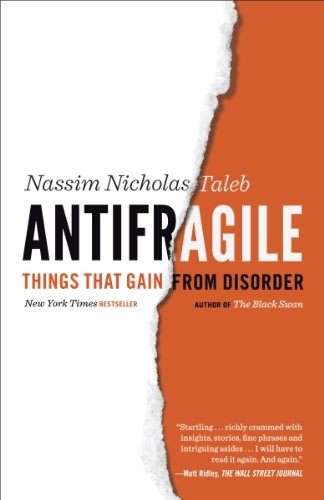

In one sentence
Because uncertainty and rare events cannot be modeled reliably, the goal should not be precise prediction or mere resistance to shocks. We should instead identify fragility, limit catastrophic downside, and design people, portfolios, institutions, and decisions so that disorder can produce more benefit than harm.
Overview
Antifragile develops the third position beyond fragile and robust: the antifragile gains from variability. Taleb applies this idea to systems that learn through trial and error, bodies that adapt to stress, decentralized economies, and strategies with limited losses and open-ended gains. He attacks centralized, optimized systems that suppress small failures and thereby accumulate hidden risk. His preferred stance is cautious experimentation: remove what causes irreversible harm, preserve optionality, and let beneficial variation operate. The book is deliberately polemical and wide-ranging rather than a systematic academic treatise.
Core ideas
Fragile, robust, antifragile
Fragile things are harmed by shocks; robust things withstand them; antifragile things improve because of them. The key question is not simply “How can this survive stress?” but “Can this be arranged to gain more from volatility than it loses?”
Convexity and asymmetry
An arrangement is antifragile when upside is larger or less limited than downside—for example, a strategy that risks small, known losses while retaining exposure to large gains. Taleb uses this asymmetry as a general decision rule, not only a financial technique.
The barbell strategy
Combine extreme safety on one side with carefully bounded speculation on the other, while avoiding the deceptively moderate middle. In life and finance, this means protecting against ruin while keeping meaningful exposure to favorable surprises.
Optionality beats prediction
When outcomes are opaque, seek choices that let you respond after information arrives. Options, experimentation, and decentralized trial-and-error can benefit from uncertainty; rigid forecasts and irreversible commitments are exposed to it.
Via negativa
Improvement often comes more reliably from removing harmful interventions than from adding supposedly beneficial ones. Taleb extends this principle to medicine, policy, diet, and personal decisions, especially where unintended effects are difficult to measure.
Small failures can protect against large failures
Frequent, limited stressors and local failures can reveal weaknesses and promote adaptation. Suppressing every disturbance may create a system that looks stable while becoming increasingly vulnerable to a rare, system-wide shock.
Distrust centralized optimization
Large, tightly coupled systems may be efficient under normal conditions but fragile under unexpected conditions. Taleb favors redundancy, slack, decentralization, diversity, and systems that can fail locally rather than catastrophically.
Time and survival as evidence
Practices that persist across generations deserve attention because survival exposes them to many unrecorded tests. This is not proof that old practices are always correct, but it is a reason to be skeptical of novel interventions claiming superiority from short-term evidence.
Practical takeaways
- Before pursuing gains, identify what could cause irreversible ruin and reduce that exposure first.
- Prefer reversible experiments and small commitments when you lack reliable information.
- Keep slack, redundancy, and backup capacity; maximum efficiency can remove the margin needed to absorb shocks.
- Look for asymmetry: limited downside, substantial upside, and the ability to stop or change course.
- Use stressors in doses that stimulate adaptation, but distinguish manageable stress from injury or catastrophe.
- Do not confuse short-term calm with long-term safety; ask what risks are accumulating underneath.
- When uncertain about an intervention, consider whether removing a harmful input is safer than adding a complex solution.
- For institutions, distribute decision-making and allow small failures instead of concentrating risk in one highly optimized system.
Caveats and counterpoints
- The book’s central distinction is useful, but Taleb’s examples do not always establish that a system truly benefits from disorder rather than merely tolerating it.
- Advice about stress, traditional practices, or medical intervention cannot be applied mechanically: a stressor may strengthen one system and damage another, and individual dose-response matters.
- Small failures are not automatically beneficial. In tightly coupled systems, local failures can spread; in human settings, allowing harm to vulnerable people is not justified by an abstract appeal to antifragility.
- Taleb’s critique of expertise and formal models is rhetorically powerful, but reviewers note that he sometimes treats personal judgments as if they were broadly demonstrated research findings.
- The barbell idea is clearer as a risk-management heuristic than as a universal life philosophy; its suitability depends on resources, time horizon, and the consequences of loss.
Questions worth revisiting
- Where in my life am I optimizing for calm or efficiency while accumulating hidden fragility?
- What downside could permanently impair me, and how can I cap or insure it?
- Which decisions can be converted into small, reversible experiments?
- Where would redundancy or slack improve reliability, even at an apparent short-term cost?
- Am I treating volatility as uniformly harmful, or can I design an asymmetric exposure to favorable surprises?
- When I admire a successful system, is its success due to skill, luck, survivorship, or a structure that genuinely benefits from randomness?
Return to this when…
Return to the book when evaluating major risks, designing experiments, making financial or career decisions under uncertainty, or reviewing systems that appear efficient but may be vulnerable to rare shocks.
Highlights
This is the tragedy of modernity: as with neurotically overprotective parents, those trying to help are often hurting us the most.
Just as being nice to the arrogant is no better than being arrogant toward the nice, being accommodating toward anyone committing a nefarious action condones it.
Wind extinguishes a candle and energizes fire. Likewise with randomness, uncertainty, chaos: you want to use them, not hide from them. You want to be the fire and wish for the wind. This summarizes this author’s nonmeek attitude to randomness and uncertainty. We just don’t want to just survive uncertainty, to just about make it. We want to survive uncertainty and, in addition—like a certain class of aggressive Roman
We just don’t want to just survive uncertainty, to just about make it. We want to survive uncertainty and, in addition—like a certain class of aggressive Roman Stoics—have the last word. The mission is how to domesticate, even dominate, even conquer, the unseen, the opaque, and the inexplicable. How?
It is far easier to figure out if something is fragile than to predict the occurrence of an event that may harm it. Fragility can be measured; risk is not measurable (outside of casinos or the minds of people who call themselves “risk experts”). This provides a solution to what I’ve called the Black Swan problem—the impossibility of calculating the risks of consequential rare events and predicting their occurrence.
While in the past people of rank or status were those and only those who took risks, who had the downside for their actions, and heroes were those who did so for the sake of others, today the exact reverse is taking place. We are witnessing the rise of a new class of inverse heroes, that is, bureaucrats, bankers, Davos-attending members of the I.A.N.D. (International Association of Name Droppers), and academics with too much power and no real downside and/or accountability. They game the system while citizens pay the price. At no point in history have so many non-risk-takers, that is, those with no personal exposure, exerted so much control. The chief ethical rule is the following: Thou shalt not have antifragility at the expense of the fragility of others.
I want to live happily in a world I don’t understand. Black Swans (capitalized) are large-scale unpredictable and irregular events of massive consequence—unpredicted by a certain observer, and such unpredictor
Black Swans (capitalized) are large-scale unpredictable and irregular events of massive consequence—unpredicted by a certain observer, and such unpredictor is generally called the “turkey” when he is both surprised and harmed by these events.
Black Swans hijack our brains, making us feel we “sort of” or “almost” predicted them, because they are retrospectively explainable. We don’t realize the role of these Swans in life because of this illusion of predictability.
Complex systems are full of interdependencies—hard to detect—and nonlinear responses. “Nonlinear” means that when you double the dose of, say, a medication, or when you double the number of employees in a factory, you don’t get twice the initial effect, but rather a lot more or a lot less. Two weekends in Philadelphia are not twice as pleasant as a single one—I’ve tried. When the response is plotted on a graph, it does not show as a straight line (“linear”), rather as a curve. In such environment, simple causal associations are misplaced; it is hard to see how things work by looking at single parts.
The antifragile gains from prediction errors, in the long run. If you follow this idea to its conclusion, then many things that gain from randomness should be dominating the world today—and things that are hurt by it should be gone. Well, this turns out to be the case. We have the illusion that the world functions thanks to programmed design, university research, and bureaucratic funding, but there is compelling—very compelling—evidence to show that this is an illusion, the illusion I call lecturing birds how to fly. Technology is the result of antifragility, exploited by risk-takers in the form of tinkering and trial and error, with nerd-driven design confined to the backstage. Engineers and tinkerers develop things while history books are written by academics; we will have to refine historical interpretations of growth, innovation, and many such things.
The Fragilista Our idea is to avoid interference with things we don’t understand. Well, some people are prone to the opposite. The fragilista belongs to that category of persons who are usually in suit and tie, often on Fridays; he faces your jokes with icy solemnity, and tends to develop back problems early in life from sitting at a desk, riding airplanes, and studying newspapers. He is often involved in a strange ritual, something commonly called “a meeting.” Now, in addition to these traits, he defaults to thinking that what he doesn’t see is not there, or what he does not understand does not exist. At the core, he tends to mistake the unknown for the nonexistent.