
In one sentence
The medium of communication strongly influences the form and seriousness of public thought. Postman’s central claim is that television turns public discourse into entertainment—not merely by presenting entertaining topics, but by making entertainment the standard by which all topics are judged. The resulting danger is closer to Huxley’s passive, pleasure-driven dystopia than Orwell’s overtly repressive one.
Overview
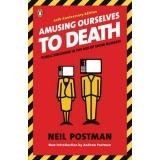
Published in 1985, the book traces a shift from a nineteenth-century culture organized around print, sustained argument, and exposition to a television culture organized around visual appeal, speed, novelty, personality, and fragmentation. Its chapters move through media theory, American intellectual history, television news, politics, religion, education, and a final comparison of Orwell’s 1984 with Aldous Huxley’s Brave New World. The 2005 Penguin edition adds an introduction by Andrew Postman.
Core ideas
The medium is a metaphor
Every medium carries an implicit theory of what counts as meaningful communication. A medium does not simply transmit a message neutrally; its structure favors certain habits of thought and makes other forms harder to sustain.
Media as epistemology
Postman treats media as systems for producing knowledge. Print encourages linearity, context, abstraction, definition, and extended attention. Television privileges immediacy, images, emotional impact, personalities, and discontinuous segments.
From typographic America to the peek-a-boo world
The telegraph and later electronic media create a world in which information arrives rapidly from everywhere, often detached from local consequences or practical action. People receive more facts while gaining less ability to use them meaningfully—the problem Postman frames through the information–action gap.
News becomes a performance
Television news is shaped by the demands of show business: visual interest, brevity, novelty, personality, and rapid transitions. The familiar “now…this” structure places unrelated events side by side, discouraging sustained context and making seriousness difficult to recognize.
Politics as image management
Televised politics rewards appearance, charisma, slogans, dramatic moments, and advertising technique. Candidates and policies become products to be packaged, while public judgment is increasingly organized around impressions rather than extended argument.
Religion and education absorb entertainment’s rules
Religious preaching becomes spectacle when visual drama and celebrity replace theological reasoning. Education likewise becomes vulnerable when engagement, amusement, and television-style presentation are treated as substitutes for disciplined inquiry.
The Huxleyan warning
Postman’s concluding contrast is not primarily about predicting a specific technology. It is about identifying a form of cultural domination in which people willingly surrender attention and intellectual seriousness because distraction is pleasurable. The threat is not that information disappears, but that it becomes abundant, fragmented, and inconsequential.
The book’s proposed response
Postman does not offer a simple program to abolish television. His remedy is cultural and educational: understand the biases of media, preserve institutions and practices that support serious discourse, and teach people to distinguish useful communication from merely attention-grabbing communication.
Practical takeaways
- Ask of any medium: What kinds of thought does its form encourage, and what kinds does it make awkward or invisible?
- When consuming news, separate novelty from importance and ask what action, if any, the information makes possible.
- Treat short, image-led political communication as presentation before treating it as argument; look for context, evidence, definitions, and trade-offs elsewhere.
- Notice whether a classroom, meeting, sermon, or civic forum is using entertainment to support understanding—or replacing understanding with entertainment.
- Build print-like habits where the subject requires them: uninterrupted reading, comparison of sources, note-taking, and arguments that develop over time.
- Do not interpret “more information” as automatically meaning better-informed citizens. Information without context, memory, or a route to action can produce passivity rather than agency.
Caveats and counterpoints
- Postman’s contrast between print and television is deliberately broad and polemical. Print cultures were not uniformly rational or democratic, and television can sometimes provide serious reporting, education, and shared civic attention.
- The book is primarily about television in the United States of the 1980s; applying it directly to the internet or social media requires interpretation rather than assuming that every later medium works identically.
- Postman often treats the effects of a medium at the level of culture, which can understate differences among programs, audiences, institutions, and uses.
- His argument is stronger as a framework for asking how media shape attention and public reasoning than as a complete empirical account of political behavior or educational outcomes.
- The publisher’s comparison to Orwell’s 1984 is misleading as a summary of the book’s emphasis: Postman explicitly develops Huxley’s pleasurable distraction as the more relevant warning.
Questions worth revisiting
- Which current forms of communication still reward sustained exposition rather than speed, personality, or visual novelty?
- Where does an apparently informative media environment leave me with no clear way to judge importance or take action?
- Do I reject a claim because it is poorly argued, or because it is presented in a form I have been trained to find boring?
- What would a genuinely serious television, online, or classroom format need to do differently?
- When does entertainment make difficult ideas more accessible, and when does it become the criterion that determines whether an idea is allowed to matter?
Return to this when…
Return to the chapters on “Media as Epistemology,” “The Peek-a-Boo World,” “Now…This,” and “The Huxleyan Warning” when evaluating news feeds, political campaigns, educational media, or any environment where attention is constantly redirected. The table of contents confirms these as the book’s central progression from media theory to social consequences.
References
- openlibrary.org
- openlibrary.org
- en.wikipedia.org
- Amusing ourselves to death : public discourse in the age of show business - Free Library Catalog
- Amusing Ourselves to Death by Neil Postman: 9780143036531 | PenguinRandomHouse.com: Books
- books.google.com
- peterlang.com
- booksplease.com
- catalog.library.camdencc.edu
- 431.jcdelama.info
- campusstore.miamioh.edu
- litcharts.com