
In one sentence
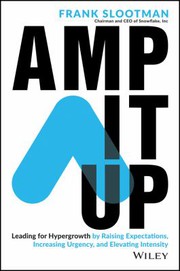
Hypergrowth depends less on discovering a perfect strategy than on changing an organization’s operating intensity. Leaders must raise expectations, clarify the mission, focus attention, improve execution, accelerate decisions, and continually challenge incrementalism. Slootman presents “amping up” as a leadership intervention that can produce immediate improvement before major changes to structure, talent, or strategy.
Overview
The book combines autobiography with an operating philosophy developed through Slootman’s leadership of Data Domain, ServiceNow, and Snowflake. Its five-part framework is to raise standards, align people and culture, sharpen focus, pick up the pace, and transform strategy. The later chapters apply these ideas to execution, hiring, sales, scaling, boards, and strategic bets.
Core ideas
Raise standards before redesigning the organization
Slootman’s starting diagnosis is that many companies are capable of more than they currently demand of themselves. Leaders should make quality, accountability, and ambition explicit rather than accepting work that is merely adequate. His premise is that leadership behavior can shift performance faster than reorganizations or outside consultants.
Make the mission concrete
A mission should be large enough to energize people, clear enough to guide choices, and translated into everyday priorities. It is not primarily a financial target; it should explain what the organization is trying to accomplish for customers and why the work matters.
Treat execution as a capability
The book places execution ahead of abstract strategy. Execution can be taught through clear ownership, direct feedback, disciplined follow-through, and repeated attention to outcomes. A strong strategy is of limited value if the organization cannot convert it into timely, coordinated action.
Hire drivers, not passengers
High-performance cultures require people who create momentum rather than wait for instructions. Slootman emphasizes selecting for initiative, ability, and commitment, while dealing decisively with persistent mismatches between an individual and the organization’s performance needs.
Focus is a leadership decision
Growth creates competing demands, so leaders must aggressively reduce the number of priorities. Useful questions include: What is the single most important outcome? What activity is marginal? What urgent action is being avoided? Focus is not a planning slogan; it is the removal of distractions and tradeoffs made visible.
Increase pace without confusing motion with progress
Urgency means shortening cycles, making decisions sooner, and refusing unnecessary delay. The intended sequence is diagnosis, prioritization, ownership, and rapid execution—not frantic activity. Pace is valuable when attached to a meaningful outcome and measurable follow-through.
Fight both competitors and incrementalism
Slootman uses competitive, sometimes military language to encourage a visceral sense of contest. The deeper target is complacency: organizations can lose while making steady improvements if rivals are moving faster or redefining the market. Audacious goals are meant to coordinate effort and prevent cautious local optimization.
Align incentives and customer outcomes
As companies scale, alignment becomes harder and more important. Shared metrics, consistent incentives, and a common definition of success help prevent departments from optimizing for themselves. The practical test is whether people can explain how their work contributes to the mission and customer value.
Practical takeaways
- Write down the organization’s one most important mission or outcome, then test every major initiative against it.
- Ask what could be accomplished in half the time, but verify that speed will not compromise reliability, safety, or customer trust.
- Replace vague praise with explicit standards: what does excellent work look like, and what evidence would show that it was achieved?
- Limit active priorities; identify which projects, meetings, or processes are consuming attention without materially advancing the mission.
- Separate strategy problems from execution problems before changing direction. The remedy for weak follow-through may be ownership, talent, cadence, or accountability—not a new strategy.
- Recruit and reward people who take initiative, tell the truth early, and close loops without requiring constant supervision.
- Use urgency as a behavior: decide, assign an owner, set a deadline, and inspect the result.
- When leading a board or founder, act as a steward of the company’s mission rather than seeking approval for every operational decision.
Caveats and counterpoints
- The framework is strongly shaped by enterprise software and high-growth technology companies; a serious review notes uncertainty about its transferability to mature industries and nontechnology sectors.
- Its language of intensity, war, drivers, and removing passengers may encourage clarity and accountability, but applied carelessly it can reward burnout, suppress dissent, or mistake constant pressure for excellence.
- The advice assumes a leader has substantial authority to change priorities, personnel, incentives, and pace. Founders, middle managers, regulated organizations, and volunteer groups may need more participatory methods.
- The book emphasizes performance and urgency more than psychological safety, inclusion, sustainability, or the organizational costs of repeated high-intensity operation; these are important counterweights rather than central themes.
- Slootman’s successes provide useful operating evidence, but they are not controlled proof that the same practices caused each company’s growth. Market timing, product quality, talent, capital, and industry conditions also matter.
Questions worth revisiting
- Where is my organization actually underperforming: standards, focus, alignment, execution, pace, or strategy?
- What would I stop doing if only one priority could receive attention this quarter?
- Which expectations are currently implicit, inconsistent, or too low?
- Am I creating urgency through clarity and ownership, or merely transmitting anxiety?
- Which people are consistently creating momentum, and which roles or relationships are persistently misaligned?
- What evidence would show that raising intensity is improving outcomes rather than simply increasing workload?
- Which parts of Slootman’s technology-company model fit my context, and which require adaptation?
Return to this when…
Return to the five-part framework—raise standards, align people, sharpen focus, pick up the pace, transform strategy—when a team feels busy but ineffective, when priorities have proliferated, or when an organization is tolerating mediocre execution. Revisit the caveats before applying the model during sustained overload or in a low-authority, highly regulated, or collaborative environment.
References
- Amp It Up: Leading for Hypergrowth by Raising Expectations, Increasing Urgency, and Elevating Intensity | Wiley
- oreilly.com
- Table of Contents - Amp It Up Book
- openlibrary.org
- guptadeepak.com
- Breaking Analysis: Amping it up with Frank Slootman - theCUBE Research
- kobo.com
- CLAUDE’S BOOK REVIEW
- rekindleinsights.com
- Amp It Up Book Review (Key Takeaways from a CEO)
- insightbooks.app
- ricklindquist.com