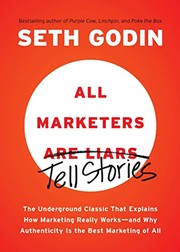

In one sentence
Marketing is primarily the creation and spread of believable stories. People interpret products through existing worldviews, biases, and social identities; therefore, effective marketers identify a specific audience, tell a story that fits its worldview, and ensure the product actually supports that story.
Overview
Godin presents marketing as meaning-making rather than information transfer. Consumers often make quick judgments, then use stories to explain and justify them. A successful story must be noticed, emotionally or socially resonant, easy to repeat, and authentic enough that both marketer and customer can believe it. The book moves from worldview and first impressions to authenticity, ethical limits, and practical competition in a crowded market.
Core ideas
People buy interpretations, not just objects
A product’s functional differences may be small, but the meaning attached to it can strongly affect perceived value. Godin uses examples such as premium cars, shoes, wine glasses, sushi, and organic products to show how beliefs alter the customer’s experience.
Worldview comes before persuasion
Customers filter new information through assumptions about status, taste, health, identity, expertise, and belonging. Marketing works better when it begins with a group’s existing worldview instead of trying to argue everyone into a new one.
The story must be authentic
“Authentic” does not simply mean factually complete or traditionally honest. It means the story is genuinely held, believable to its audience, and reinforced by the actual product or experience. A mismatch between promise and delivery eventually destroys trust.
First impressions create the frame
People notice what is new or distinctive, form an initial hypothesis, and then interpret subsequent evidence through that frame. Packaging, price, design, setting, and social signals therefore shape how features are perceived.
Specific audiences beat mass-market vagueness
The strongest stories are usually designed for a particular group, especially early adopters who already care about the problem or identity involved. Their adoption and word-of-mouth can make the story spread beyond the initial niche.
Marketing is not limited to advertising
Every organization communicates a story through its product, service, employees, pricing, distribution, and customer experience. In Godin’s formulation, marketing is what an organization does to create meaning and make its offering matter—not merely what it says in advertisements.
The title is deliberately provocative
Godin’s “liars” are storytellers who simplify and frame reality; the argument is not a defense of fraud. The ethical dividing line is whether the story helps customers choose an experience the product can genuinely provide, rather than exploiting them with a false promise.
Practical takeaways
- Define the smallest audience whose worldview makes your offer especially relevant.
- Ask: What story will this audience tell itself after using the product?
- Identify the audience’s existing assumptions before writing copy or choosing channels.
- Make the first impression consistent with the intended position: price, design, language, setting, and social proof should reinforce one another.
- Sell the complete experience and meaning, not an undifferentiated list of features.
- Give early adopters something remarkable and easy to talk about.
- Treat every operational detail as part of the brand story.
- Test authenticity by comparing the promise with what customers actually experience and repeat to others.
Caveats and counterpoints
- The book relies heavily on illustrative anecdotes and provocative generalizations rather than a systematic body of empirical research; its examples are useful prompts, not proof that every market behaves the same way.
- “Worldview” is a powerful but broad concept. It can encourage insightful segmentation, but it may also lead marketers to stereotype audiences or overread symbolic preferences.
- The book’s language about lies and belief can blur an important ethical distinction between framing a genuine benefit and manipulating customers with deception. Consumer-protection, privacy, and truth-in-advertising constraints remain essential.
- Storytelling cannot compensate for poor product quality, weak distribution, bad economics, or an offer that fails to solve a meaningful problem.
- The advice is strongest for differentiated, experience-based, or identity-laden products; it is less decisive where purchasing is governed mainly by regulation, technical specifications, reliability, or lowest total cost.
Questions worth revisiting
- What worldview does the intended customer already hold, and what evidence supports that assumption?
- What is the simplest believable story connecting the offer to the customer’s desired identity or outcome?
- Which parts of the product experience make the story true rather than merely persuasive?
- Would existing customers describe the product using the same story the company tells?
- Where does persuasive framing become misleading omission or manipulation?
- Is the offer genuinely distinctive, or is storytelling being used to disguise parity?
- Which early adopters would benefit enough to share the story without being paid to do so?
Return to this when…
Return to this book when positioning a new product, refining a brand narrative, designing a launch for a niche audience, or diagnosing why technically strong marketing is not being believed. The most useful refresher is: start with the audience’s worldview, construct a credible story, and make the product deliver it.
Highlights
Here’s the first half of the simple summary: We believe what we want to believe, and once we believe something, it becomes a self-fulfilling truth. (Jump
this summary) If you think that more expensive wine is better, then it is. If you think your new boss
If you think that more expensive wine is better, then it is. If you think your new boss is going to be more effective, then she will be. If you love the way a car handles, then you’re going to enjoy driving it. That sounds so obvious, but if it is, why is it so ignored? Ignored by marketers, ignored by ordinarily rational consumers, and ignored by our leaders. Once we move beyond the simple satisfaction of needs, we move into the complex satisfaction of wants. And wants are hard to measure and difficult to understand. Which makes marketing the fascinating exercise it is.
Here’s the second part of the summary: When you are busy telling stories to people who want to hear them, you’ll be tempted to tell stories that just don’t hold up. Lies. Deceptions. This sort of storytelling used to work pretty well. Joe McCarthy became famous while lying about the “Communist threat.” Bottled water companies made billions while lying about the purity of their product compared with tap water in the developed world. The thing is, lying doesn’t pay off anymore. That’s because when you fabricate a story that just doesn’t hold up to scrutiny, you get caught. Fast.
Here are the questions I hope you’ll ask (your boss, your colleagues, your clients) after you’ve read this book: “What’s your story?” “Will the people who need to hear this story believe it?” “Is it true?” Every day, we see mammoth technology brands fail because they neglected to ask and answer these questions. We see worthy candidates gain little attention and flawed ones bite the dust. There are small businesses that are so focused on what they do that they forget to take the time to describe the story of why they do it. And on and on. If what you’re doing matters, really matters, then I hope you’ll take the time to tell a story.
So, go tell a story. If it doesn’t resonate, tell a different one. When you find a story that works, live that story, make it true, authentic, and subject to scrutiny. All marketers are storytellers. Only the losers are liars.
have no intention of telling you the truth. Instead I’m going to tell you a story. This is a story about why marketers must forsake any attempt to communicate nothing but the facts, and must instead focus on what people believe and then work to tell them stories that add to their worldview. Make no mistake. This is not about tactics or spin or little things that might matter. This is a whole new way of doing business. It’s a fundamental shift in the paradigm of how ideas spread. Either you’re going to tell stories that spread, or you will become irrelevant.
We tell stories to our spouses, our friends, our bosses, our employees and our customers. Most of all, we tell stories to ourselves. Marketers are a special kind of liar. Marketers lie to consumers because consumers demand it. Marketers tell the stories, and consumers believe them. Some marketers do it well. Others are pretty bad at it. Sometimes the stories help people get more done, enjoy life more and even live longer. Other times, when the story isn’t authentic, it can have significant side effects and consumers pay the price. The reason all successful marketers tell stories is that consumers insist on it. Consumers are used to telling stories to themselves and telling stories to each other, and it’s just natural to buy stuff from someone who’s telling us a story. People can’t handle the truth.
Nobody buys pure design from Number 17. They buy the way the process makes them feel. So what do real estate, graphic design and wine glasses have in common? Not a lot. Not price point or frequency of purchase or advertising channels or even consumer sales. The only thing they have in common is that no one buys facts. They buy a story.
The way Stephanie felt when she bought the Pumas was the product. Not the sneakers (made for $3 in China). She could have bought adequate footwear for a fraction of what the Pumas cost. What the marketers sold her was a story, a story that made her feel special. Stories (not ideas, not features, not benefits) are what spread from person to person. Make no mistake—this was not an accident. Puma works hard to tell a story. It’s a story about hipness and belonging and fashion—and it has built its entire business around the ability to tell this story.
great story is true. Not true because it’s factual, but true because it’s consistent and authentic. Consumers are too good at sniffing out inconsistencies for a marketer to get away with a story that’s just slapped on. When
A great story is true. Not true because it’s factual, but true because it’s consistent and authentic. Consumers are too good at sniffing out inconsistencies for a marketer to get away with a story that’s just slapped on.
Great stories make a promise. They promise fun or money, safety or a shortcut. The promise is bold and audacious and not just very good—it’s exceptional or it’s not worth listening to.
Great stories are trusted. Trust is the scarcest resource we’ve got left. No one trusts anyone. Consumers don’t trust the beautiful women ordering vodka at the corner bar (they’re getting paid by the liquor company). Consumers don’t trust the spokespeople on commercials (who exactly is Rula Lenska?) and consumers don’t trust the companies that make pharmaceuticals (Vioxx, apparently, can kill you). As a result, no marketer succeeds in telling a story unless he has earned the credibility to tell that story.
Great stories are subtle. Surprisingly, the less a marketer spells out, the more powerful the story becomes. Talented marketers understand that the prospect is ultimately telling himself the lie, so allowing him (and the rest of the target audience) to draw his own conclusions is far more effective than just announcing the punch line.
Great stories happen fast. They engage the consumer the moment the story clicks into place. First impressions are far more powerful than we give them credit for. Great stories don’t always need eight-page color brochures or a face-to-face meeting. Great stories match the voice the consumer’s worldview was seeking, and they sync right up with her expectations. Either you are ready to listen to what a Prius delivers or you aren’t.
Great stories don’t appeal to logic, but they often appeal to our senses. Pheromones aren’t a myth. People decide if they like someone after just a sniff. And the design of an Alessi teapot talks to consumers in a way that a fact sheet about boiling water never could.
Great stories are rarely aimed at everyone. Average people are good at ignoring you. Average people have too many different points of view about life and average people are by and large satisfied. If you need to water down your story to appeal to everyone, it will appeal to no one. Runaway hits like the LiveStrong fund-raising bracelets take off because they match the worldview of a tiny audience—and then that tiny audience spreads the story.
Great stories don’t contradict themselves. If your restaurant is in the right location but has the wrong menu, you lose. If your art gallery carries the right artists but your staff is rejects from a used car lot, you lose. If your subdivision has lovely wooded grounds but ticky-tacky McMansions, you lose. Consumers are clever and they’ll see through your deceit at once.
And most of all, great stories agree with our worldview. The best stories don’t teach people anything new. Instead, the best stories agree with what the audience already believes and makes the members of the audience feel smart and secure when reminded how right they were in the first place.
If you care about the future of your company, your nonprofit, your church or your planet, marketing matters. Marketing matters because whether or not you’re in a position to buy a commercial, if you’ve got an idea to spread, you’re now a marketer. Key fact: in 2003 pharmaceutical companies spent more on marketing and sales than they did on research and development. When it comes time to invest, it’s pretty clear that spreading the ideas behind the medicine is more important than inventing the medicine itself.
The authenticity of the story determines whether it will survive scrutiny long enough for the consumer to tell the story to other people. Sometimes marketing is so powerful it can actually change the worldview of someone who experiences it, but no marketing succeeds if it can’t find an audience that already wants to believe the story being told.
There are only two things that separate success from failure in most organizations today: 1. Invent stuff worth talking about. 2. Tell stories about what you’ve invented. Make up great stories. That’s the new motto. This is urgent. The transformation of our organizations has been under way for a while, but now, thanks to outsourcing and computers and increasing manufacturing quality, it’s easier than it’s ever been to get something made, shipped and stocked. Easier than ever to ensure quality and durability. What’s difficult—really difficult—is figuring out what’s worth making and then telling a story about it.
The explanation for this variety lies in the worldview all consumers carry around. It turns out that we don’t all want the same things! Each person has a different set of biases and values and assumptions, and those worldviews are influenced by their parents, their schools, the places they live and the experiences they’ve had to date. Their worldview is the lens they use to determine whether or not they’re going to believe a story. As the great Red Maxwell said, “Lenses distort things.” The lens your consumers use shows them a different version of reality than it shows you or your colleagues or your other customers.
Don’t try to change someone’s worldview is the strategy smart marketers follow. Don’t try to use facts to prove your case and to insist that people change their biases. You don’t have enough time and you don’t have enough money. Instead, identify a population with a certain worldview, frame your story in terms of that worldview and you win.
If you want to attract some squirrels, put out some acorns. It’s a safe bet. Nuts are something that squirrels need, the same way people need water and food. But once we start talking about more sophisticated products, things that people want instead of need, the discussion gets complicated. Even extremely poor consumers in the developing world will prioritize their purchases to get what they want, often ignoring the opportunity to take what they need.
Worldviews are the reason that two intelligent people can look at the same data and walk away with completely different conclusions—it’s not that they didn’t have access to the data or that they have poor reasoning skills, it’s simply that they had already put themselves into a particular worldview before you even asked the question. Marketing succeeds when enough people with similar worldviews come together in a way that allows marketers to reach them cost-effectively.
Marketers don’t hesitate to run different ads for men and women, for the rich and the poor, for those that travel and those that don’t. The mistake is that we don’t go far enough. There isn’t one market. There are a million markets, each filled with people who share a worldview. The most successful, fastest-moving examples are those where the marketer used a frame to leverage an existing worldview, not to change one. Your opportunity lies in finding a neglected worldview, framing your story in a way that this audience will focus on and going from there.
Regardless of “reality” (as determined by double-blind studies, extensive research or a cold, hard look at the facts), the statements above are easily believed or disbelieved by different individuals. Add them (and a thousand others) all up and you’ve defined the biases that a particular consumer brings to the table. This seems obvious, doesn’t it? It does to me. It seems really clear that everyone is different and those differences explain what we pay attention to and what we ignore. Yet just about every marketer (job seeker, nonprofit, political candidate, beer manufacturer, and so on) treats every consumer as a potential customer. Not just a potential customer, but a potential customer who is just like all the other potential customers out there.
Of course, all customers are not the same, but they’re not all different either. People clump together into common worldviews, and your job is to find a previously undiscovered clump and frame a story for those people.
It’s so tempting to tell your story to an audience that desperately wants to hear it. The problem is that this audience may embrace your story but might not make you any money (or get you elected). It’s not enough to find a niche that shares a worldview. That niche has to be ready and able to influence a large group of their friends.
The cereal business had a great run. For more than twenty years, prices were raised, shelf space increased, profits went up and demand was steady. Then Atkins hit. The worldview of a big chunk of the audience changed, almost overnight. Suddenly moms weren’t so eager to relive their childhood by serving refined sugars and flours to their kids for breakfast. Interstate Bakeries, the folks that bring you Twinkies and Wonder Bread, went bankrupt. All of a sudden, the lies consumers told themselves about breakfast cereal and wholesomeness were under pressure. Jay Gouliard (the guy who brought us Gogurt) and his team at General Mills saw the change and decided to take action. Less than one hundred days after they decided to change their story, every major cereal brand at General Mills was converted to 100 percent whole grain. Lucky Charms’ new whole-grain formulation is a rapid response to a brand-new worldview: the awareness among an audience of parents that whole-grain food is a lot better for them and their kids. General Mills didn’t invent Atkins, but once Atkins changed the bias of a large audience, General Mills was quick enough to tell a story to those people—while they were still listening. Four things make General Mills’ response likely to work: First, they did it quickly, so they stood out by being first. Second, the cereal still tastes great. And third, they leveraged the stories that have worked for so long (“magically delicious!”) to give the new story weight. Finally, and most important, the new frame they are hanging around their old brands will find a large audience that shares the low-carb worldview.
People don’t want to change their worldview. They like it, they embrace it and they want it to be reinforced.
Once you’ve presented a story to people who share your worldview and are paying attention, the vernacular you use becomes astonishingly important. The words, colors, typefaces, images, media, packaging, pricing—all the ways you can possibly color your story—become far more important than the story itself.
This is why copywriting and Web design and photography are so important. Why it matters how your sales force dresses and speaks. When Pat Holt strings together a list of words not to overuse—“Actually, totally, absolutely, completely, continually, constantly, continuously, literally, really, unfortunately, ironically, incredibly, hopefully, finally”—she’s not being a stickler for formality and grammar. Instead she’s reminding us that words matter, that poor word use is just a red flag for someone who wants to ignore you.
Over and over, marketers focus at the center of every curve they encounter. And every time, they’re disappointed. The center is crowded, jammed with noise and devoid of unfilled wants. It’s at the edges that you’ll find people with an unfulfilled worldview.
A WORLDVIEW IS NOT A COMMUNITY By definition communities share (some) worldviews. The community of soccer moms in my town, for example, have similar (but not identical) biases about everything from politics to automobiles. That’s pretty obvious. What makes them a community is that they talk to each other. They share ideas and adjust their biases and choices based on what other members of the community do. When the first soccer mom bought a minivan, it started a buzz, a buzz that spread through the community as each mom considered the story behind this new kind of car. But a shared worldview doesn’t make a community! Individuals who don’t like car salesmen, for example, aren’t part of a coherent community. They just share a bias: they don’t talk to each other because they’re not particularly interested in the other people who also hate car dealers.
Not only the rich compete for the privilege of telling stories. We see precisely the same behavior in companies bidding up the price of domain names and consumers waiting in line to spend $1 on a yellow charity bracelet. It doesn’t matter if you’re selling $3 socks at Kmart or $3,000,000 paintings in Miami. A lot of people want what everyone else is buying.
PUTTING FRAMES TO WORK Imagine that your boss has charged you with introducing a new kind of salty snack food, a chip of some sort. In the old model, you’d identify a target market, find media that reached that market, create some advertising and run it. You’d pay slotting allowances and get your bags of chips (in brightly colored packages) into the chip aisle. Perhaps you’d run some coupons. Starting from a worldview model, you’d approach it differently. Understanding that the chip aisle of the supermarket is jammed (as is your target consumer’s ability to pay attention), you can start over by identifying a segment that might notice a new story, told in a different way. In this case, let’s choose moms that believe “salty snacks aren’t healthy and my kids don’t eat them.” This mom doesn’t go down the snack food aisle at the supermarket. She doesn’t notice advertisements for snack foods either. She seems a poor prospect for this product, but if you can tell the right story, the market is yours for the taking. So you design the story. The chips will be made from soy, not potatoes. They will be non-GMO, organic, low-fat and salted with a little sea salt and dulse, for flavor, not sodium. The chips will come in a box, not a bag, and you won’t sell them in the snack aisle at all: instead, you’ll pay to have them slotted in the produce department. Now you’re telling a very different story. You’re using frames to match the worldview of the segment you’re trying to reach. And if you do it right, there’s an excellent chance they’ll notice the change in the environment and will give your story a try. If the chips are good (and assuage mom’s slight guilt over depriving her kids of chips!) then you’ve made a convert. And no, moms with this worldview aren’t a cohesive community. But moms are still moms, and moms talk to each other. Your target moms will start serving the chips at birthday parties and sending them into school with lunches. They might even mention how much their kids like the chips at the next neighborhood get-together. So the story spreads. Pretty soon people who don’t share their worldview will be seeking out the chips. Soon after that you’ll be able to move the chips to the snack aisle, because you’ve shared your story and your audience will follow.
Step 1: Every consumer has a worldview that affects the product you want to sell. That worldview alters the way they interpret everything you say and do. Frame your story in terms of that worldview, and it will be heard.
I’m amazed to find myself writing this, but the purpose of this book is to persuade you to be less rational. Stop trying to find the formula that will instantly make your idea into a winner. Instead of being scientists, the best marketers are artists. They realize that whatever is being sold (a religion, a candidate, a widget, a service) is being purchased because it creates an emotional want, not because it fills a simple need. Marketers win when they understand the common threads that all successful stories share. In the legendary words of Judy Garland, “Hey kids! Let’s put on a show.”
LOOK FOR A DIFFERENCE When we encounter something for the first time, we compare it to the status quo. If it’s not new, we ignore it.
LOOK FOR CAUSATION (COINCIDENCE) Once we decide to pay attention to something, our brain sets to work to figure out how it happened. If a window breaks, we want to see the golf ball on the floor. We instantly make up a rule or a theory about how this thing came to occur.
USE OUR PREDICTION MACHINE Then we make a prediction. We predict what will happen next in our world. If our prediction is right, then the external surprises will cease and our brain can settle back in and start ignoring things again.
RELY ON COGNITIVE DISSONANCE Once we’ve made up our mind, once we’ve got some assumptions about causation and we’ve made some predictions, then we stick with them. We ignore contrary data for as long as we can get away with it and focus on the events we agree with.
The frog’s secret? It watches only for changes in the environment. It has a brain that can only do one thing well, and that’s watch the sky for moving bugs. By ignoring the static environment and only focusing on what’s new, it can be far more efficient than a human when it comes to catching flies. Humans use the same strategy far more often than we realize. Not to catch flies, of course, but to keep up with the huge influx of data we wrestle with every day. Have you ever caught your car odometer flipping from 999 to 1,000? You may not remember ever having looked at your odometer before, but somehow, by strange coincidence, you catch it during the big change. Obviously it’s not a coincidence at all. We’re constantly scanning the world around us for changes. Walk into your house and within a heartbeat you know if something has changed. You glance at your watch a dozen times in a row without consciously knowing what time it is—until you discover that you’re late for something, and then the data jumps to the forefront of your awareness. Yes, we’re just like frogs. We notice changes most of all. No, we can’t grab a fly, but we can tell at a glance if there’s a new brand of beer at the market or if the mail-man got a haircut.
A quick look at the song count on my iPod confirmed that this is exactly what happens—some songs are played ten times as often as others. But that’s the way it’s supposed to be. That’s the way randomness works. Random doesn’t mean perfectly even. Far from it. These superstitious iPod owners, though, had made a decision about what their player liked (and what it didn’t like). They gave the machine a personality. Whenever a particular song came up again, they made a mental note of it. “Aha! See, it does love Fatboy Slim. There he is again.” Of course, they were just as quick to ignore those instances when a rarely played song came up. That’s
Step 2: People only notice stuff that’s new and different. And the moment they notice something new, they start making guesses about what to expect next.
In Malcolm Gladwell’s brilliant book Blink, he proves conclusively that humans make decisions on almost no data—and then stick with those decisions regardless of information that might prove them wrong. We decide that a politician is just like us, and it doesn’t matter a lot when he misspeaks, makes poor decisions or even gets indicted. We’ve already made up our minds and we’re going to look at everything that happens through the rose-colored glasses we put on after that first meeting.
The problem with first impressions isn’t that they’re not important (They are important! They’re crucial!) but that we have no idea at all when that first impression is going to occur. Not the first contact, but the first impression. That’s why authenticity matters. It doesn’t really matter whether a story we tell to a consumer is completely factual. If it’s a good story, if that story is framed in terms of his worldview, then he’ll tell himself the story and believe in the lie. The reason authenticity matters is that we don’t know which inputs the consumer will use to invent the story he tells himself.
So here’s the deal: 1. Snap judgments are incredibly powerful. 2. Humans do everything they can to support those initial judgments. 3. They happen whether you want your prospects to make a quick judgment or not. 4. One of the ways people support snap judgments is by telling other people. 5. You never know which input is going to generate the first impression that matters. 6. Authentic organizations and people are far more likely to discover that the story they wish to tell is heard and believed and repeated.
Spending an inordinate amount of time and money on your sign or your jingle or your Web site is beside the point. It’s every point of contact that matters. If you’re not consistent and authentic, the timing of that first impression is too hard to predict to make it worth the journey. On the other hand, if you can cover all the possible impressions and allow the consumer to make them into a coherent story, you win.
Step 3: Humans are able to make extremely sophisticated judgments in a fraction of a second. And once they’ve drawn that conclusion, they resist changing it.
Marketers freaked out (and I use that term carefully) when the television-industrial complex came crumbling down. They panicked because they had been living and thriving under the illusion that marketing = advertising, and when advertising stopped working, they had no idea at all what to do. P&G and other big advertisers spent millions trying to invent television-like commercials for the Web. (You can still find committees and commissions that lobby for this sort of thing within the Net community). Pretty quickly, though, they discovered that if people could skip the ads, they would.
Now we know that marketing = storytelling, and everything an organization does supports the story. So everyone is in the marketing department and a company either tells a story that people care about, or their story disappears.
Alyssa is buying bottled water. Not because she’s thirsty. Thirst can be quenched for free anywhere in the United States. What she wants is convenience or peace of mind or the satisfaction of knowing that she’s got water from Fiji or Tanzania in her hand. She buys bottled water because she wants it, not because she needs it. If consumers have everything they need, there’s nothing left to buy except stuff that they want. And the reason they buy stuff they want is because of the way it makes them feel.
But is the utility of the product the main way people shape their desires? No way! And that, in two words, is why you need the ideas in this book. In almost every meeting I go to, people are desperate to understand why their product or service isn’t selling better. They always begin by pointing out how good their product is, how much better/faster/more durable it is. They are obsessed with the utility and they can’t understand why the market isn’t responding to their microanalysis of the difference between their offering and that of their competitor. We don’t need what you sell, friend. We buy what we want.
Step 4: Stories let us lie to ourselves. And those lies satisfy our desires. It’s the story, not the good or the service you actually sell, that pleases the consumer.
If someone leaves the store feeling better than when she arrived, my friend has successfully told a story. The consumer will tell herself a lie—a lie about how a few ounces of fabric can make her feel sexy, perhaps. And that lie will spread, guaranteeing the store a loyal (and profitable) following. So growth starts with better questions. Questions about storytelling, not about commodities.
You don’t get to just sit down and make up a story and expect that people will believe it merely because you want them to. Consumers are too clever for that. You can’t claim your workmen’s comp insurance agency has the best service and expect that the lie will strike a chord. You can’t insist that shopping at your store is fun and expect that people will rush on over just to experience it. This is a hard lesson for a lot of marketers to learn. It’s easy to tout your features, focus on the benefits, give proof that you are, in fact, the best solution to a problem. But proof doesn’t make the sale. Of course, you believe the proof, but your audience doesn’t. The very fact that you presented the proof makes it suspect. If a consumer figures something out or discovers it on her own, she’s a thousand times more likely to believe it than if it’s just something you claim. This is where the art of marketing occurs. For most products and services, skywriting, billboards and telemarketing are precisely the wrong ways to spread a message. Not because they won’t be noticed—they probably will. But because they won’t be believed. In order to be believed, you must present enough of a change that the consumer chooses to notice it. But then you have to tell a story, not give a lecture. You have to hint at the facts, not announce them. You cannot prove your way into a sale—you gain a customer when the customer proves to herself that you’re a good choice. The process of discovery is more powerful than being told the right answer—because of course there is no right answer, and because even if there were, the consumer wouldn’t believe you!
Expectations are the engine of our perceptions. And complex stories carry all sorts of perceptions. Where people choose to shop, the way the transaction is handled, the noise, the music, the lighting—each element is at least as important as the item itself. Ralph Lauren generates a huge portion of its sales from seconds and job lots sold at the many Polo factory stores around the country. There are so many of these stores (and the demand is so high) that many of the items sold aren’t seconds at all. They’re designed and produced for the factory stores. People tell themselves a story about finding a bargain, they build up the expectation by driving thirty miles out of their way (while on vacation, no less) and then are delighted to spend $40 for a $400 jacket that was never intended to be sold for $400 and probably cost $4 to make.
Which leads us to the fibs and the frauds. Georg Riedel is a fibber—an honest liar. He’s an honest liar because he tells his customers something that isn’t true—his glasses make wine taste better—and then the very act of believing his lie makes the statement true. Because drinkers believe the wine tastes better, it does taste better. Storytelling works when the story actually makes the product or service better.
fraud, on the other hand, is a story based on little or nothing. It’s a story you tell primarily for personal gain. And worst of all, a fraud, when discovered (and it will be discovered), enrages your consumer—probably forever.
Just because people might believe your story doesn’t give you a right to tell it!
I was clear about this in Purple Cow and I’ll repeat myself here: if you want to grow, make something worth talking about. Not the hype, not the ads, but the thing. If your idea is good, it’ll spread. The public demands that you tell them a story. The story is part of the product or service that they buy—in many cases, the story is what people set out to buy. But at the core of a story is the thing, the real thing, the essence of what you’ve built. And if you try to build on a rotten core, you’ll succeed for a bit but then you’ll lose.
The good news is clear: authentic marketing, from one human to another, is extremely powerful. Telling a story authentically, creating a product or service that actually does what you say it will leads to a different sort of endgame. The marketer wins and so do her customers. A story that works combined with authenticity and minimized side effects builds a brand (and a business) for the ages.
Belief in the lie must not ultimately harm the consumer because if it does, you’ll run out of consumers and credibility far too soon.
You don’t get to make up the story. The story happens with or without you. If you’re not happy with the story, the only way to change it is with direct contact between your consumer and a person. That person might be the consumer’s neighbor or friend or teacher or boss. Or it might be one of your employees. Personal interaction cuts through all the filters. Personal interaction is the way human beings actually make big decisions—by looking people in the eye, by experiencing them firsthand. That’s why it was so hard for the dot-coms to build a loyal following—they couldn’t afford to provide the interactions that are built into the retail experience.
The goal of every marketer is to create a purple cow, a product or experience so remarkable that people feel compelled to talk about it. Remarkable goods and services help ideas spread—not hype-filled advertising.
The challenge lies in figuring out what’s remarkable and actually making the remarkable happen. I believe the best way to do that is to craft a story that someone enjoys telling to himself. Before we are able to share a story with friends, colleagues or the Internet, we need to tell it to ourselves. Politicians call these talking points. Retailers call it an experience. If you can build your entire organization around delivering a particular story, you’ve dramatically increased the chances that this story will actually get told.
Humans are too smart to be fooled by a Potemkin village, a facade that pretends to be one thing and turns out to be another. Sure, you can fool some people once or twice, but this is the key lesson of the new marketing: once fooled, a person will never repeat your story to someone else. If you are not authentic, you will get the benefit of just one sale, not a hundred. The cost of your deception is just too high.
Some senses count for more than others, but every sense matters. • the way a home smells when you visit an open house • the clicking sound a cell phone makes when you dial it • the location within a strip mall when you choose a restaurant • the display in the window • the way the receptionist answers the phone • the typeface on the flyer • the identity of the person calling you on the phone soliciting a donation It’s worth stopping for a second to understand how significant a change we’re now dealing
This is standard marketing stuff with a new spin. Except it’s not. Because successful stories never offer the things marketers are most likely to feature: very good quality. A slightly better price. The best you can get under the circumstances. A decent commodity at a decent price. Convenience. Nice people. A quality brochure. Few defects. Industry-standard warranty. None of these attributes are story-worthy.
The principles behind creative storytelling are compelling, but what do you do when you have competition? How do you respond to competing stories in the marketplace? The most important principle is this: you cannot succeed if you try to tell your competition’s story better than they can. It’s almost impossible to out-yell someone with the same story. Years ago I gave a presentation to the Wal-Mart Internet team. They gave me a tour of their offices, which featured a huge banner that read “You can’t out-Amazon Amazon.” At the time, Wal-Mart was more than one hundred times bigger than their smaller competitor in Seattle. If Wal-Mart was afraid to go after Amazon, what chance do you have against your entrenched competition? This is the most difficult competitive lesson to learn. Marketers (and all human beings) are well trained to follow the leader. The natural instinct is to figure out what’s working for the competition and then try to outdo it. To be cheaper than your competitor who competes on price, or faster than the competitor who competes on speed. The problem is that once a consumer has bought someone else’s story and believes that lie, persuading the consumer to switch is the same as persuading him to admit he was wrong. And people hate admitting that they’re wrong.
Instead, you must tell a different story and persuade those listening that your story is more important than the story they currently believe. If your competition is faster, you must be cheaper. If they sell the story of health, you must sell the story of convenience. Not just the positioning x/y axis sort of “we are cheaper” claim, but a real story that is completely different from the story that’s already being told. Woot.com is a modern Internet
Most often you’re charged with competing with someone who has already succeeded with a story that’s taken hold. (It’s easier for investors and bosses to spend time and money going after a proven market, even though proven markets are the hardest to break into.) The competition’s story has already spread through a community that shares a worldview, and your boss wants you to reach that same community with your story—she figures all you’ve got to do is frame it.
The best alternative strategy is to find a different community, with a different worldview that wants to hear a different story. This matches the classic case of 7-Up described in Positioning (selling the UnCola to people who didn’t want to buy Coke) but it goes far deeper than that.
What if you’re entering a market where there is already successful competition and they’ve all bought your competition’s story? That means that your competition is already telling a story that’s working. In order to grow, you can’t tell the same story to the same people (even if you tell it louder or with more style). Instead you will find success by telling a different story to part of the community with a particular worldview that’s different from that of the masses. For example, Masa, the $300-per-person sushi restaurant in New York, went to people who liked eating out and people who loved sushi and told them a different story: “This is the best sushi in the world, but only for people who are willing to pay for it.” Until the moment Masa showed up, there was a community of people who wanted to hear a story framed around sushi. This is convenient sushi or great sushi or a good value in sushi. This group was treated as a homogeneous group, sharing just one worldview: we like sushi. Masa told a story to only part of that community. He told a story to people who in addition to the “I like sushi” worldview wanted to hear a story framed around “deluxe” and “best in the world.” Some people in the “I love sushi” community heard this story and believed it. It was framed with their worldview about food as well as their self-esteem and feelings about spending money. Other people said, “That’s ridiculous.” So by splitting the sushi worldview into two groups—the big group that believes sushi couldn’t be worth that money and the smaller group that was willing and able to believe the story—Masa was able to peel off enough people to create a success. The restaurant will become a profitable institution only if the experience they’ve promised is actually delivered and remarkable enough that this new community starts bringing their friends. While the worldview you are looking at may appear monolithic, it almost certainly is not. When the Fortune 500 started hiring vice presidents to spend their billions of dollars on information technology, it appeared that all five hundred of these chief information officers (CIOs) had the same worldview. Pretty soon, though, alert competitors discovered that some of them wanted to hear stories about avoiding risk, while others desperately wanted to make a name for themselves by appearing to be risk-taking mavericks. Companies like Broadview and IBM and Cisco carved up the market by working hard to discover who would believe which story.
INVISIBLE OR REMARKABLE? In Purple Cow, I argued that safe was risky, that in a cluttered world, the only way to grow was to do something remarkable. Now almost all the way through this book, I can hear you breathing a sigh of relief. “We can just tell a story!” It seems like an easy out. Figure out some internally approved story that you can trot out to the sales force and use in a magazine ad, and you’re set. Actually if you do that, you’re dead. You can’t just use any story. You can’t tell a selfish story from your point of view. You can’t invent an inauthentic story or tell an amazing story when the reality is banal. More than a thousand times since 2002, people have written to me and said, “We have a purple cow but we don’t know how to get the word out.” Guys, if you really have a purple cow (in the eyes of the consumer, not in the eyes of you or your board) you won’t have any trouble at all getting the word out. The only stories that work, the only stories with impact, the only stories that spread are the “I can’t believe that!” stories. These are the stories that aren’t just repeatable: these are the stories that demand to be repeated. Your story doesn’t have to be salacious or noisy or over the top. But it must be remarkable. Too often marketers are so self-absorbed that they believe that their story deserves to spread. Hey, you don’t get to decide what spreads—the public does. Authentic stories that earn the right to be passed on will be passed on. It’s up to you, the marketer, to earn that right.
If you tell the right kind of story, you’ll automatically become purple. All great stories are purple cows for one simple reason: a great story is believed and the lie is retold. Which means it’s a remarkable story, which means you’re a purple cow.
You’re not the only one who wants to tell a story. As a result, your tepid, compromised approaches to storytelling—stories that will please everyone, even those who don’t want to hear them—are likely to fail. The reason so many successful new offerings are run by non-compromising nutcases is that these true-blue storytellers refuse to compromise. These people may be no fun to work for, but they have the ability to tell a coherent, consistent story that is the same from every angle. They’re not faking it—they’re living the story and those who want to hear it find that they understand the story loud and clear.
Being remarkable, going to the edges, doing something worth talking about—these are all things that are rewarded with action by communities that care deeply. You succeed by being an extremist in your storytelling, then gracefully moving your product or service to the middle so it becomes more palatable to audiences that are persuaded by their friends, not by you.
If a story is what leads to a lie the consumer believes, why not call this book perhaps the more factually correct All Marketers Tell Stories? I was trying to go to the edges. No one would hate a book called All Marketers Tell Stories. No one would disagree with it. No one would challenge me on it. No one would talk about it. A talented marketer is someone who takes a story and expands it and sharpens it until it’s not true anymore (yet). Your goal should not (must not) be to create a story that is quick, involves no risks and is without controversy. Boredom will not help you grow.
I believe the purple cow is at the heart of just about every business success story of the last decade. What I missed in that book was that the remarkable element must be part of a bigger story, a piece of cognitive dissonance that actually changes the way a consumer perceives what you make. And in order to do that, you must aggressively go to the edges and tell a story that no one else could tell.
There are no small stories. Only small marketers. If your story is too small, it’s not a story, it’s just an annoying interruption. Kudos to Little Miss Match for taking a little product and turning it into a big story. Make your story bigger and bigger until it’s important enough to believe.
The Nissan Armada and the Mitsubishi Montero are SUVs with needlessly flared wheel wells. The flares don’t do anything functional—they only make a big car look bigger and more imposing. Of course, that is functional, since the function of the car itself is to appear big. As we saw earlier, that’s the reason people buy an SUV in the first place! The cars are muscle-bound, with undulating waves of sheet metal surrounding the tires, making it clear to anyone who drives by that this car is not going to take anything from anyone. Which is why the bean counters at Consumer Reports are dead wrong. The flaring isn’t needless at all. A smart marketer in the design department understands that telling a story through the design of the sheet metal is an incredibly cheap way to sell a very expensive car. Does it make the SUV work better? Well, if your goal is to drive from here to Cleveland, no SUV is going to offer you the best solution. But if your goal is to feel powerful and demonstrate that power to other people, this SUV does exactly what it’s supposed to do. It gives you a story you can believe, a lie you can tell yourself every time you see the car.
The UK travel firm Lunn Poly uses tiny electric dispensers to send wafts of coconut scent through their retail travel agency offices. The smell “has an immediate reaction with customers because it reminded them of suntan lotion and tropical places.” Nobody needs a trip to the Greek Isles. But the things that make us want one are subtle indeed. If travel agencies spent more time with coconut oil and less time finding lower prices on their terminals, they wouldn’t be under as much threat from the likes of Travelocity. They need to deliver a personalized experience that you can’t get sitting at your keyboard.
There are four reasons why your new release failed: 1. No one noticed it. 2. People noticed it but decided they didn’t want to try it. 3. People tried it but decided not to keep using it. 4. People liked it but didn’t tell their friends.
Every day people are afraid to get on airplanes, even though they are far safer than the car we take to get to the airport. Fear isn’t rational. That’s what makes it fear, not common sense.
WHAT’S YOUR STORY? That’s what people want to know from you. They want your résumé, your packaging, your candidacy, your ads and your customer service people to tell them a story. So the challenge you face is now clear. You must have a consistent, authentic story that is framed in terms of the worldview of the person you’re telling the story to. Your story must be robust and honest and transparent and you have to be prepared to live it out loud. Yes, all marketers are liars. But the successful ones are the ones that can honestly tell us a story we want to believe and share. IF you hope to sell a product or service or candidate or organization that affects the way people feel, AND IF you hope to get a premium (in revenue or in market share or in votes) for that feeling, THEN you must refocus your efforts. Concentrate on the story you tell. The story you tell affects the way your audience feels about the product. The story, when you come right down to it, is the product. SOME CONSUMERS will avoid or resist or deny you your story. That’s okay. Tell your story to people who want to hear it, who want to believe it, who will tell their friends. BEFORE you begin to tell your story you have no choice but to live that story. To make it authentic. Every action you take and every signal you send has to be in support of the story. FINALLY, realize that you are in a powerful position and use that power to do the right thing, to tell the whole truth and to spread ideas worth spreading.
References
- All Marketers are Liars: The Power of Telling Authentic Stories in a Low ... - Seth Godin - Google Books
- All Marketers are Liars: The Power of Telling Authentic Stories in a Low ... - Seth Godin - Google Books
- en.wikipedia.org
- books.google.com
- search.worldcat.org
- search.worldcat.org
- blinkist.com
- catalog.scld.org
- books.google.ne
- goodreads.com
- goodreads.com
- researchasahobby.com