
In one sentence
The best solution is not always the most logical one. Because human choices are shaped by framing, emotion, symbolism, status, habit, and context, organizations should supplement analysis with imaginative experiments designed around real human psychology.
Overview
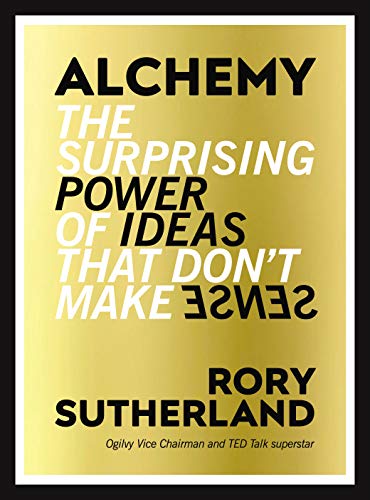
Sutherland’s book is a provocative, anecdote-driven case against treating people as rational calculators. He does not reject evidence or science outright; his target is the narrow use of logic and measurement that ignores subjective value. The recurring move is to reframe a problem: instead of asking how to make something objectively better, ask how to make it feel better, signal more, or remove a psychological obstacle. Examples discussed in reviews include cake mix requiring an added egg, “Continue as Guest” improving online checkout, and renaming Patagonian toothfish as Chilean sea bass.
Core ideas
Perceived value is psychologically constructed
People do not respond only to objective utility. Names, packaging, rituals, prices, sensory cues, and surrounding stories can alter what an experience means—and therefore what it is worth to someone.
Use “psycho-logic,” not just formal logic
A logically efficient intervention may fail if it conflicts with feelings, identity, loss aversion, status concerns, or expectations. Effective marketing often works by changing interpretation rather than changing the underlying product.
Counterintuitive ideas deserve testing
Sutherland’s “alchemy” is the search for ideas that appear irrational but produce useful behavioral effects. The practical discipline is not believing every strange idea; it is making room for experiments that conventional business reasoning would dismiss too early.
The opposite of a good idea may also work
Human preferences are not governed by one universal optimum. Consumers may value both luxury and frugality, scarcity and popularity, novelty and familiarity—depending on context, identity, and the job the choice performs.
Design for extremes, not only averages
Unusual or demanding users can reveal overlooked possibilities. Designing exclusively for the average customer may optimize the existing category while missing innovations that begin at the edges.
Reframe the problem before optimizing it
Organizations often improve a narrow metric while worsening the wider experience. Ask whether the stated problem is the real problem, whether the metric captures value, and whether a symbolic or psychological intervention could outperform an expensive functional fix.
Logic has institutional advantages—and costs
Conventional reasoning is easy to defend after the fact, so organizations may prefer safe, explainable decisions over imaginative ones. This helps explain why “rational” approaches persist even when they are unimaginative or poorly matched to human behavior.
Practical takeaways
- When a product underperforms, investigate meaning and emotion—not only features, price, or distribution.
- Change the frame before changing the object: test names, defaults, sequence, presentation, rituals, and signals of quality.
- Treat customer behavior as evidence about hidden motives, not merely as a response to stated preferences.
- Run small, reversible experiments on apparently silly ideas; judge them by measured behavior rather than internal plausibility.
- Include unconventional users and edge cases in research; they may expose new product possibilities.
- In sales, identify what the buyer is protecting—status, certainty, identity, reputation, or avoidance of loss—not just what they claim to want.
- Keep a rational control group. A counterintuitive idea is valuable only if it works better under the relevant conditions.
Caveats and counterpoints
- The book is primarily an argument for creative experimentation, not a predictive theory that tells you exactly when irrational ideas will succeed.
- Its evidence is heavily anecdotal and advertising-oriented; memorable success stories can encourage hindsight bias and survivorship bias. One reviewer specifically criticized the book’s straw-man treatment of “logic” and its limited guidance on when behavioral insights reliably generalize.
- “People are irrational” should not become an excuse to ignore evidence, economics, accessibility, or product quality. Psychological framing cannot permanently compensate for a bad underlying offer.
- Some recommendations are most applicable to marketing, experience design, and persuasion; their transfer to public policy or complex organizational problems is less certain.
- The book’s breezy, contrarian style can make its claims feel more settled than the supporting evidence warrants. Treat the anecdotes as hypotheses to test, not universal laws.
Questions worth revisiting
- What does the customer actually value: function, feeling, identity, status, reassurance, convenience, or story?
- Which part of our solution is objectively useful but psychologically unattractive—or objectively minor but symbolically powerful?
- Are we optimizing a metric that customers do not experience as value?
- What unusual customer, use case, or constraint might reveal a better design?
- What low-cost experiment could test the supposedly irrational alternative?
- Would the idea still work if the novelty, framing, or social signal disappeared?
- What evidence would prove that this is a genuine behavioral insight rather than a compelling anecdote?
Return to this when…
Return to this book when a marketing, sales, product, or policy problem seems trapped between expensive functional fixes and weak customer response. Its most useful reminder is: before optimizing the obvious solution, question the model of human behavior behind the problem.
References
- Book review: Alchemy, by Rory Sutherland
- Alchemy: The Surprising Power of Ideas That Don't Make Sense by Rory Sutherland | Goodreads
- visionone.co.uk
- goodreads.com
- Alchemy | Communication Arts
- overthinkerspod.com
- Rory Sutherland: Alchemy — Alex Murrell
- fortuitouslyfailingforward.com
- adityarao.wordpress.com
- gabrieltrabka.com
- nathansamuel.co.uk
- themaiacompany.medium.com