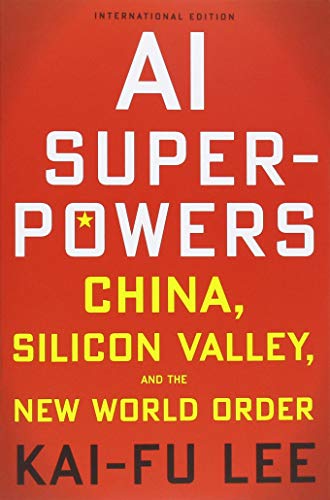

In one sentence
AI leadership depends less on isolated scientific breakthroughs than on the ability to deploy, monetize, and continuously improve systems at scale. Lee argues that China may rival or surpass the United States in applied AI, while both countries face a more consequential challenge: managing rapid automation without allowing wealth, dignity, and opportunity to concentrate among a small technical elite.
Overview
The book combines a comparative history of Chinese and American technology ecosystems with an accessible account of deep-learning applications. Its central contrast is between Silicon Valley’s strength in foundational research and China’s strengths in implementation: abundant data, intense competition, a huge user base, fast-moving companies, and government support. Lee’s later chapters shift from national competition to the social consequences of AI, especially job displacement and the need to cultivate forms of human value that machines cannot provide. The published contents organize this progression around China’s technology rise, the four waves of AI, the social crisis, and a proposed blueprint for coexistence.
Core ideas
AI advantage is an ecosystem effect
Lee presents four mutually reinforcing ingredients of an AI superpower: large quantities of usable data, capable and persistent entrepreneurs, skilled researchers and engineers, and a policy environment willing to fund and accelerate deployment. His argument is that national advantage comes from the interaction of these factors, not from talent or algorithms alone.
China’s perceived weakness—copying—can become an implementation strength
Lee argues that Chinese firms’ willingness to imitate, iterate, compete aggressively, and adapt products to local conditions helped create a fast feedback loop: more users generate more data, better data improves products, and better products attract more users. This is a claim about commercialization and deployment, not necessarily about superiority in basic research.
The four waves of AI
Lee divides AI’s development into Internet AI, business AI, perception AI, and autonomous AI. The sequence moves from recommendation and personalization, to prediction and optimization in organizations, to systems that interpret speech, images, and other sensory input, and finally to machines acting in the physical world.
Narrow AI can be economically revolutionary without being generally intelligent
The book focuses primarily on deep-learning systems that perform bounded tasks—recognition, prediction, recommendation, fraud detection, medical analysis, and similar applications. Lee’s labor argument therefore does not require human-level general intelligence: widespread automation can arise from many specialized systems embedded throughout the economy.
Automation threatens meaning as well as income
Lee’s concern is not limited to blue-collar displacement. He predicts substantial effects on white-collar work and emphasizes the psychological damage that can follow when people lose not only wages but also status, purpose, and a sense of being needed.
The proposed response is redistribution plus human-centered institutions
Lee argues that governments and companies should prepare for disruption through social support, education, and mechanisms that share AI-generated wealth. He also emphasizes care, compassion, creativity, relationships, and service as areas where humans can preserve distinctive value rather than competing directly with machines on efficiency.
The geopolitical frame is also an ethical warning
Although the book is structured as a U.S.–China contest, Lee ultimately urges both countries to recognize the responsibilities that accompany technological power. The implied danger is a race focused only on dominance, deployment, and profit while neglecting inequality, privacy, governance, and human welfare.
Practical takeaways
- When evaluating an AI strategy, inspect the whole ecosystem: data access, distribution, engineering talent, incentives, capital, regulation, and feedback loops.
- Distinguish research leadership from implementation leadership. A company or country can trail in foundational breakthroughs yet lead in deployment and commercialization.
- Expect AI’s first-order effects to appear in ordinary business processes—recommendation, screening, prediction, customer service, logistics, and monitoring—before fully autonomous machines become widespread.
- Assess automation projects by asking what happens to displaced workers’ income, status, training, and identity—not merely whether productivity rises.
- Build human advantages around trust, judgment, empathy, care, accountability, and relationships; these are complements to automation, not just fallback occupations.
- Treat national AI advantage as contingent rather than permanent. Lee’s framework depends on data access, policy, market structure, and social conditions that can change.
Caveats and counterpoints
- This is a 2018 forecast. Its framework predates the widespread adoption of generative AI and should not be read as a current account of frontier-model capabilities or the present U.S.–China technology balance.
- Lee’s China analysis is informed by his position as a technology executive and investor there. Reviewers have argued that he is too sympathetic to China’s political system and insufficiently attentive to censorship, limited dissent, privacy, and institutional brittleness.
- The book’s emphasis on China’s abundant data and permissive data environment can understate the costs of surveillance, weak privacy protections, and state power; data volume alone does not guarantee useful, representative, or trustworthy AI.
- Predictions of rapid, massive job displacement are presented forcefully but are not the same as demonstrated forecasts. Adoption depends on costs, regulation, organizational redesign, worker resistance, task complexity, and whether AI substitutes for or complements labor.
- The “four waves” model is memorable but simplified. AI development is overlapping rather than cleanly sequential, and the categories can obscure differences among technical capabilities, business models, and physical-world deployment.
- The book’s U.S.–China binary leaves less room for Europe, India, Japan, Southeast Asia, open-source communities, and multinational supply chains—actors that also shape AI development.
Questions worth revisiting
- Which parts of Lee’s ecosystem model remain useful after the rise of generative AI, and which assumptions were specific to deep-learning applications of the late 2010s?
- Does abundant data still provide a decisive national advantage when synthetic data, transfer learning, foundation models, and compute access matter so much?
- What policy could redistribute AI gains without preserving unproductive jobs or giving governments excessive control over citizens and firms?
- How should productivity gains be measured if the social cost includes loss of dignity, autonomy, privacy, or professional judgment?
- Where does Lee’s distinction between uniquely human value and automatable work break down—for example, in care, art, persuasion, or emotional support?
- What evidence would confirm or falsify the claim that China’s implementation culture can overcome disadvantages in basic research, chips, institutions, or international trust?
Return to this when…
Return to the book for its compact comparative framework—research versus deployment, data versus talent, and productivity versus human meaning. Revisit it alongside newer work on generative AI, labor-market evidence, semiconductor supply chains, privacy, and Chinese technology policy rather than treating its 2018 forecasts as settled facts.
References
- AI Superpowers: China, Silicon Valley, and the New World Order - Kai-Fu Lee - Google Books
- All Book Marks reviews for AI Superpowers: China, Silicon Valley, and the New World Order by Kai-Fu Lee Book Marks
- en.wikipedia.org
- studylib.net
- Kai-Fu-Lee (2019): AI Superpowers—China, Silicon Valley and the New World Order - PMC
- Review of AI Superpowers: China, Silicon Valley, and the New World Order, by Kai Fu Lee – thork.net
- voljournals.utk.edu
- conscioused.org
- arxiv.org
- thinkingaheadinstitute.org
- fortune.com
- en.wikipedia.org