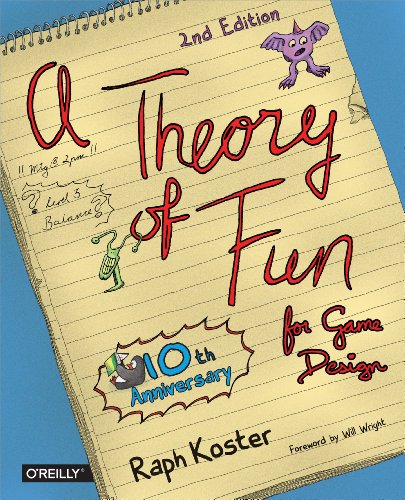

In one sentence
Fun arises when a game presents patterns that players can learn, practise, and master, making good game design a craft of building meaningful systems whose challenges remain legible without becoming trivial.
Overview
Raph Koster approaches games through learning. The brain constantly compresses experience into patterns, and the pleasure called fun often appears when a player recognizes a new pattern or improves at applying one. A game supplies rules, feedback, and variation that let this learning happen safely and repeatedly. Boredom arrives when the pattern is fully understood; frustration arrives when the player cannot form a useful model.
This account separates a game’s underlying formal system from its fictional presentation. Graphics and story can make an experience inviting and meaningful, but they cannot rescue an empty set of decisions. Koster also argues that games teach values and ways of seeing, whether designers intend them to or not. The medium should therefore grow beyond familiar survival, conflict, and status patterns toward systems capable of expressing a wider range of human experience.
Core ideas
Fun is the pleasure of learning
Players enjoy discovering rules, noticing relationships, testing hypotheses, and improving their predictions. Mastery produces satisfaction, but complete mastery removes the uncertainty that sustains play.
Games are compressed models
A game removes much of reality and preserves a tractable system of relationships. Its meaning comes from what the model includes, rewards, and leaves out.
Challenge must track capability
Good games keep players near the boundary between comprehension and uncertainty. Difficulty without readable feedback feels arbitrary; repetition without variation feels solved.
Mechanics teach through action
Players learn what a game values by doing, receiving feedback, and adapting. A system’s incentives can communicate a different message from its story or visual theme.
The medium can express more
Many games reuse patterns of territorial control, combat, accumulation, and hierarchy. Designers can broaden the medium by modelling social, emotional, creative, and cooperative systems with equal depth.
Practical takeaways
- Identify the pattern the player is meant to learn in every major mechanic.
- Provide fast, intelligible feedback that helps players update their model.
- Add meaningful variation before repetition becomes rote.
- Test the rules without their theme to see whether the decisions remain interesting.
- Compare the behaviour rewarded by the mechanics with the message claimed by the fiction.
- Design for several levels of mastery so beginners can understand the system while experts keep discovering structure.
Caveats and counterpoints
- Learning explains much game enjoyment, but social connection, fantasy, performance, sensory pleasure, collection, and self-expression also matter.
- Different players enjoy different balances of novelty, competence, uncertainty, and relaxation.
- Separating mechanics from presentation can understate how fiction and aesthetics change the meaning of an action.
- A game can be valuable without remaining endlessly replayable or difficult.
- Ethical interpretation depends on players and context as well as the designer’s formal system.
Questions worth revisiting
- What exactly is the player learning during each minute of play?
- Which feedback helps the player form a better model of the system?
- When does mastery become boredom, and what new layer appears next?
- What values do the incentives teach regardless of the written story?
- Which human experiences remain poorly represented as playable systems?
Return to this when…
Return to this book when a game is polished but not engaging, when difficulty feels arbitrary, or when the theme and mechanics appear to communicate different things. It provides a direct way to examine the patterns, feedback, and learning underneath the presentation.