
In one sentence
Because publicly available information is rapidly incorporated into market prices, consistently identifying mispriced securities or timing markets is exceptionally difficult. For most investors, a diversified, low-cost, mostly passive portfolio—held patiently and matched to personal risk and time horizon—is more reliable than stock picking, market forecasting, or paying professionals to pursue outperformance.
Overview
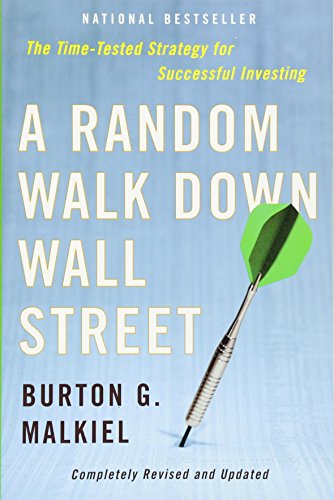
Malkiel moves from the history of speculative manias to the major approaches investors use to beat the market: technical analysis, fundamental analysis, and newer quantitative strategies. He then presents the random-walk and efficient-market perspectives, reviews evidence on professional fund performance, and translates the argument into portfolio construction and life-cycle investing. The 13th edition is the fiftieth-anniversary edition, published in 2024; the catalogue description’s emphasis on the dot-com crash does not adequately represent the book’s broader and more recently updated scope.
Core ideas
Bubbles are recurring, persuasive, and expensive
The historical tour of market manias is meant to expose a repeating pattern: a plausible story attracts attention, rising prices reinforce confidence, and investors mistake momentum for proof. The practical defense is skepticism toward fashionable narratives and unusually high returns.
A random walk means short-term price movements are hard to forecast
Past price patterns generally provide little dependable information about the next price move. Malkiel uses this to challenge chart-reading and technical trading: once a profitable pattern becomes widely known, trading on it should tend to weaken or eliminate it.
Fundamental analysis is useful but not a dependable edge for most people
Estimating a company’s value requires forecasts about earnings, interest rates, competition, and investor psychology. Even careful analysts can be wrong, and any genuine advantage is competed away. Fundamental research may inform judgment, but it does not make consistent outperformance easy.
Markets can be imperfect without being easy to beat
Malkiel’s position is not that prices are always correct or that markets are perfectly rational. It is that exploitable errors are difficult to identify in advance and difficult to trade after costs. His later discussion acknowledges behavioral and predictability critiques while maintaining that markets are generally more efficient than many claims suggest.
Costs turn average performance into below-average investor returns
Fees, trading costs, taxes, and mistakes create a persistent handicap for active strategies. A low-cost index fund accepts market returns before costs and avoids paying for an uncertain search for alpha—the central practical reason passive investing is favored.
Diversification is the portfolio’s primary free lunch
Holding many securities and asset classes reduces the damage caused by any single company, sector, or country. The goal is not to eliminate volatility but to avoid uncompensated, concentrated risk while retaining exposure to long-term economic growth.
Asset allocation matters more than security selection
The appropriate mix of stocks, bonds, and other assets depends on time horizon, financial obligations, income stability, and ability to tolerate losses. Younger investors with long horizons can generally bear more equity risk; investors near or in retirement need greater protection against large withdrawals during a downturn.
The investor’s behavior is part of the return
Even a sound portfolio can fail if the investor panics, chases recent winners, trades excessively, or abandons the plan during a crash. Regular saving, periodic rebalancing, and staying invested are behavioral disciplines, not merely technical details.
Practical takeaways
- Use broad, low-cost index funds as the default core of a portfolio rather than trying to select winning stocks or funds.
- Diversify across companies, sectors, countries, and—when appropriate—stocks and bonds.
- Set an asset allocation based on time horizon and loss tolerance before a market crisis tests it.
- Invest regularly instead of waiting for a supposedly predictable entry point.
- Rebalance periodically, but avoid turning rebalancing into frequent speculation.
- Evaluate funds by total cost, diversification, tax consequences, and tracking quality—not by recent performance alone.
- Treat extraordinary return promises, market forecasts, and investment fads as reasons to investigate rather than automatically buy.
- Recognize that indexing does not remove risk: a broad equity index can still fall sharply and may be unsuitable for near-term spending needs.
Caveats and counterpoints
- The book’s strongest conclusion is a practical one—most investors should not expect to beat the market—not a claim that every market is perfectly efficient or every price is intrinsically correct.
- Academic and professional critics argue that returns can show some predictability and that psychological behavior can affect prices; Malkiel’s own survey acknowledges these challenges but argues that they are commonly overstated and hard to exploit after costs.
- A market-capitalization index can become concentrated in highly valued companies or sectors. Diversification protects against individual failures but does not protect against broad market overvaluation or systemic shocks.
- The life-cycle guidance is a framework, not individualized financial advice. Debt, taxes, pensions, insurance, emergency reserves, health, and withdrawal needs can materially change the appropriate portfolio.
- Index funds are not automatically superior when they are expensive, narrowly focused, leveraged, illiquid, or used without regard to the investor’s time horizon.
Questions worth revisiting
- What evidence in the book most directly supports the claim that active managers fail to outperform after fees?
- Which parts of Malkiel’s argument depend on the efficient-market hypothesis, and which remain persuasive even if markets are partly inefficient?
- What asset allocation would fit my actual time horizon, emergency savings, debts, and ability to tolerate a 30–50% equity decline?
- Am I pursuing an evidence-based strategy, or reacting to a recent winner, persuasive story, or fear of missing out?
- What costs—expense ratios, taxes, spreads, advisory fees, and unnecessary trading—are reducing my realized return?
Return to this when…
Return to the sections on bubbles when a fashionable investment feels obviously inevitable; to the active-versus-passive discussion when considering a stock, advisor, or managed fund; and to the life-cycle guidance before changing asset allocation or approaching a major financial goal.
Highlights
It is the definition of the time period for the investment return and the predictability of the returns that often distinguish an investment from a speculation. A speculator buys stocks hoping for a short-term gain over the next days or weeks. An investor buys stocks likely to produce a dependable future stream of cash returns and capital gains when measured over years or decades.
Turnover reached an all-time high. The average holding period for a typical stock was no longer years or months but days and even hours.
By early 2000, the biggest price changes were 50 percent or more. And there were 10 million Internet “day traders,” many of whom had quit their jobs to go down the easy path to riches. For them, the long term meant later in the morning. It was lunacy. People who would spend hours researching the pros and cons of buying a $50 kitchen appliance would risk tens of thousands on a chat-room tip.
The key to investing is not how much an industry will affect society or even how much it will grow, but rather its ability to make and sustain profits.
Anomalies can crop up, markets can get irrationally optimistic, and often they attract unwary investors. But, eventually, true value is recognized by the market, and this is the main lesson investors must heed. I am also persuaded by the wisdom of Benjamin Graham, author of Security Analysis, who wrote that in the final analysis the stock market is not a voting mechanism but a weighing mechanism. Valuation metrics have not changed. Eventually, every stock can only be worth the present value of the cash flow it is able to earn for the benefit of investors. In the final analysis, true value will win out. The important investment question is how you can estimate true value.
Despite its plausibility and scientific appearance, there are three potential flaws in this type of analysis. First, the information and analysis may be incorrect. Second, the security analyst’s estimate of “value” may be faulty. Third, the market may not correct its “mistake,” and the stock price may not converge to its value estimate.
Rule 1: Buy only companies that are expected to have above-average earnings growth for five or more years.
Rule 2: Never pay more for a stock than its firm foundation of value.
What is proposed, then, is a strategy of buying unrecognized growth stocks whose earnings multiples are not at any substantial premium over the market. Of course, it is very hard to predict growth. But even if the growth does not materialize and earnings decline, the damage is likely to be only single if the multiple is low to begin with, whereas the benefits may double if things do turn out as you expected. This is an extra way to put the odds in your favor.
Look for growth situations with low price-earnings multiples. If the growth takes place, there’s often a double bonus—both the earnings and the multiple rise, producing large gains. Beware of very high multiple stocks in which future growth is already discounted. If growth doesn’t materialize, losses are doubly heavy—both the earnings and the multiples drop.
Rule 3: Look for stocks whose stories of anticipated growth are of the kind on which investors can build castles in the air. I have
So Rule 3 says to ask yourself whether the story about your stock is one that is likely to catch the fancy of the crowd. Is it a story from which contagious dreams can be generated? Is it a story on which investors can build castles in the air—but castles
Indeed, the analysts’ strong buy recommendations underperformed the market as a whole by 3 percent per month, while their sell recommendations outperformed the markets by 3.8 percent per month.
Again, the evidence from several studies is remarkably uniform. Investors have done no better with the average mutual fund than they could have done by purchasing and holding an unmanaged broad stock index.
Basically, there are four factors that create irrational market behavior: overconfidence, biased judgments, herd mentality, and loss aversion.
References
- en.wikipedia.org
- reiprime.com
- assets.press.princeton.edu
- Burton G. Malkiel | Julis-Rabinowitz Center for Public Policy & Finance
- books.google.com
- The Efficient Market Hypothesis and Its Critics - American Economic Association
- A Random Walk Down Wall Street - Description | W. W. Norton & Company Ltd.
- dof.princeton.edu
- princetonlibrary.bibliocommons.com
- onlinelibrary.wiley.com
- investmentnews.com
- pegasus.law.columbia.edu