
In one sentence
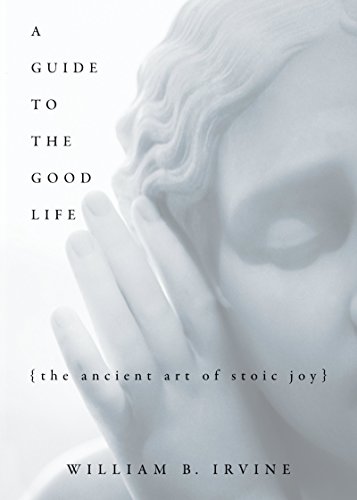
A good life requires an explicit philosophy of living, not merely a succession of short-term goals. Irvine argues that Stoic practices can produce greater tranquility—or “Stoic joy”—by changing our judgments, expectations, and habits rather than by controlling external events.
Overview
The book has four movements: a popular history of Stoicism; a toolkit of psychological exercises; advice for recurring human problems; and a defense of adapting Stoicism to modern life. Its emphasis is deliberately practical and accessible, rather than a complete account of Stoic logic, physics, theology, or technical ethics.
Core ideas
Begin with a philosophy of life
Irvine’s starting question is not “What do I want next?” but “What is my highest aim in living?” Without a governing aim, daily goals can accumulate without forming a coherent life.
Negative visualization
Regularly imagine losing possessions, relationships, abilities, or opportunities. The point is not pessimism; it is to interrupt habituation, make ordinary goods visible again, and prepare emotionally for impermanence. The exercise can also clarify what is genuinely valuable.
Control what can actually be controlled
Separate outcomes into what is entirely outside your control, partly influenced by you, and directly governed by your choices. For partly controllable activities, adopt internal goals—such as effort, judgment, or integrity—rather than making success depend on winning or approval.
Accept the past and present as given
Irvine’s version of Stoic fatalism recommends learning from what happened without wishing reality had been different. For the present, replace constant comparison with acceptance of the actual situation, then choose the best response available now.
Use voluntary discomfort and meditation
Occasional deliberate simplicity or discomfort tests dependence on comfort and strengthens appreciation. Daily review—observing how you responded to events—turns Stoicism into an iterative practice rather than an abstract belief system.
Reframe emotional disturbances
Anger, insults, grief, status anxiety, and fear often intensify through interpretation. Irvine recommends delay, perspective, humor, nonresponse, retrospective appreciation, and attention to what is morally up to you. The goal is not emotional numbness but fewer self-created disturbances.
Value virtue over reputation and luxury
Fame is unstable because it depends on other people’s judgments. Luxury can also weaken appreciation by making comfort feel necessary. A Stoic therefore treats status and wealth as usable but nonessential, while preserving character and freedom from dependence.
Stoicism is an adaptation, not a neutral summary
The book centers tranquility and practical exercises, and it presents Stoic methods as usable even without commitment to Stoic theology. A scholarly review notes that this emphasis sidelines technical distinctions and may substitute tranquility for the classical Stoic priority of virtue.
Practical takeaways
- Write down a one-sentence account of what makes a life go well; use it to evaluate competing goals.
- Once a day, notice one ordinary good and briefly imagine its absence—not to induce fear, but to resist taking it for granted.
- Before pursuing an outcome, identify the part that belongs to your effort, judgment, preparation, or conduct. Make that your primary target.
- When irritated, insert a pause and ask: What exactly happened? What judgment am I adding? What response would preserve my character?
- Practice a small, safe form of voluntary simplicity occasionally to discover which comforts are preferences rather than necessities.
- Review the day in concrete terms: where did I act well, where did I react automatically, and what will I try next time?
- Treat criticism, praise, money, convenience, and status as conditions to navigate—not as the foundation of self-worth.
Caveats and counterpoints
- This is a practical modern interpretation of Stoicism, not a comprehensive scholarly treatment; it largely omits technical doctrines such as Stoic theories of indifferent things and differentiated duties.
- The reviewer argues that Irvine gives tranquility a more central role than classical Stoics would, potentially shifting the goal from virtue to emotional stability.
- Some recommendations—especially around grief, anger, and emotional restraint—can be too blunt if applied to trauma, depression, bereavement, or situations requiring support and action. The book’s advice should not replace appropriate care.
- The control framework is useful for attention and effort, but “control” is not binary: social, political, economic, and bodily conditions can constrain choices even when one’s response remains partly available.
Questions worth revisiting
- What would I pursue if other people’s approval were removed from the calculation?
- Which recurring distress comes mainly from an external event, and which part comes from my interpretation of it?
- What ordinary good have I become least able to notice because it is familiar?
- Where would accepting reality improve my response—and where would it become an excuse for passivity?
- Which Stoic exercise helps me most: negative visualization, control distinctions, voluntary discomfort, or evening review?
- Does Irvine’s emphasis on tranquility preserve the ethical core of Stoicism, or make it primarily a stress-management system?
Return to this when…
Return to the chapters on negative visualization, control, and meditation when feeling anxious about outcomes; revisit the sections on anger, grief, fame, and luxury when a specific recurring disturbance appears. For historical or doctrinal questions, pair this book with a scholarly introduction to Stoicism because Irvine intentionally prioritizes practical application over technical completeness.
Highlights
The Cynics were renowned for their wit and wisdom. When, for example, someone asked what sort of woman a man should marry, Antisthenes replied that no matter what woman he chose for his wife, he would live to regret marrying: “If she’s beautiful, you’ll not have her to yourself; if she’s ugly, you’ll pay for it dearly.” Concerning our dealings with other people, he commented that “it is better to fall in with crows than with flatterers; for in the one case you are devoured when dead, in the other case while alive.” He also advised his listeners to “pay attention to your enemies, for they are the first to discover your mistakes.”
In defense of simple living, Diogenes observed that “the gods had given to men the means of living easily, but this had been put out of sight, because we require honeyed cakes, unguents and the like.” Such is the madness of men, he said, that they choose to be miserable when they have it in their power to be content.
The problem is that “bad men obey their lusts as servants obey their masters,” and because they cannot control their desires, they can never find contentment.
When asked about his lack of an abode, Diogenes would reply that he had access to the greatest houses in every city—to their temples and gymnasia, that is. And when asked what he had learned from philosophy, Diogenes replied, “To be prepared for every fortune.”7 This reply, as we shall see, anticipates one important theme of Stoicism.
Instead, it depends on her excellence as a human being—on how well she performs the function for which humans were designed. In the same way that a “virtuous” (or excellent) hammer is one that performs well the function for which it was designed—namely, to drive nails—a virtuous individual is one who performs well the function for which humans were designed. To be virtuous, then, is to live as we were designed to live; it is to live, as Zeno put it, in accordance with nature.18 The Stoics would add that if we do this, we will have a good life.
We experience hunger; this is nature’s way of getting us to nourish ourselves. We also experience lust; this is nature’s way of getting us to reproduce. But we differ from other animals in one important respect: We have the ability to reason. From this we can conclude, Zeno would assert, that we were designed to be reasonable.
(The Meditations was a private journal—the original title was To Himself—and was published only after Marcus’s death.)
Misfortune weighs most heavily, he says, on those who “expect nothing but good fortune.”
Epictetus echoes this advice: We should keep in mind that “all things everywhere are perishable.” If we fail to recognize this and instead go around assuming that we will always be able to enjoy the things we value, we will likely find ourselves subject to considerable distress when the things we value are taken from us.
We also experience hedonic adaptation in our relationships. We meet the man or woman of our dreams, and after a tumultuous courtship succeed in marrying this person. We start out in a state of wedded bliss, but before long we find ourselves contemplating our spouse’s flaws and, not long after that, fantasizing about starting a relationship with someone new.
He counsels us, for example, when we kiss our child, to remember that she is mortal and not something we own—that she has been given to us “for the present, not inseparably nor for ever.” His advice: In the very act of kissing the child, we should silently reflect on the possibility that she will die tomorrow.7 In his Meditations, by the way, Marcus Aurelius approvingly quotes this advice.
In his Handbook, Epictetus advocates this sort of “projective visualization.” Suppose, he says, that our servant breaks a cup.15 We are likely to get angry and have our tranquility disrupted by the incident. One way to avert this anger is to think about how we would feel if the incident had happened to someone else instead. If we were at someone’s house and his servant broke a cup, we would be unlikely to get angry; indeed, we might try to calm our host by saying “It’s just a cup; these things happen.” Engaging in projective visualization, Epictetus believes, will make us appreciate the relative insignificance of the bad things that happen to us and will therefore prevent them from disrupting our tranquility.
Along similar lines, Seneca, after advising us to enjoy life, cautions us not to develop “over-much love” for the things we enjoy. To the contrary, we must take care to be “the user, but not the slave, of the gifts of Fortune.”17 Negative visualization, in other words, teaches us to embrace whatever life we happen to be living and to extract every bit of delight we can from it. But it simultaneously teaches us to prepare ourselves for changes that will deprive us of the things that delight us. It teaches us, in other words, to enjoy what we have without clinging to it. This in turn means that by practicing negative visualization, we can not only increase our chances of experiencing joy but increase the chance that the joy we experience will be durable, that it will survive changes in our circumstances.
We need to keep firmly in mind that everything we value and the people we love will someday be lost to us. If nothing else, our own death will deprive us of them. More generally, we should keep in mind that any human activity that cannot be carried on indefinitely must have a final occurrence. There will be—or already has been!—a last time in your life that you brush your teeth, cut your hair, drive a car, mow the lawn, or play hopscotch. There will be a last time you hear the sound of snow falling, watch the moon rise, smell popcorn, feel the warmth of a child falling asleep in your arms, or make love. You will someday eat your last meal, and soon thereafter you will take your last breath.
More generally, if we cannot resist pleasures, we will end up playing, Marcus says, the role of slave, “twitching puppetwise at every pull of self-interest,” and we will spend our life “ever grumbling at today or lamenting over tomorrow.”
Epictetus thinks the admiration of other people is a negative barometer of our progress as Stoics: “If people think you amount to something, distrust yourself.”5
We will discover, says Epictetus, that our feelings aren’t hurt when others tell us that we know nothing or that we are “mindless fools” about things external to us. We will shrug off their insults and slights. We will also shrug off any praise they might direct our way.
Other signs of progress, says Epictetus, are the following: We will stop blaming, censuring, and praising others; we will stop boasting about ourselves and how much we know; and we will blame ourselves, not external circumstances, when our desires are thwarted. And because we have gained a degree of mastery over our desires, we will find that we have fewer of them than we did before; we will find, Epictetus says, that our “impulses toward everything are diminished.” And quite significantly, if we have made progress as a Stoic, we will come to regard ourselves not as a friend whose every desire must be satisfied but “as an enemy lying in wait.”
Similarly, a Stoic novice might boast of her simple lifestyle or of giving up wine in favor of water; a more advanced Stoic, having adopted a simple lifestyle and having given up wine in favor of water, will feel no need to comment on the fact. Indeed, Epictetus thinks that in our practice of Stoicism, we should be so inconspicuous that others don’t label us Stoics—or even label us philosophers.8
Of the kinds of humor we might use in response to an insult, self-deprecating humor can be particularly effective. Along these lines, Seneca describes a man, Vatinius, whose neck was covered with wens and whose feet were diseased, who joked about his own deformities so much that others had nothing to add.11 Epictetus also advocates the use of self-deprecating humor. Suppose, for example, you find out that someone has been saying bad things about you. Epictetus advises you to respond not by behaving defensively but by questioning his competence as an insulter; for example, you can comment that if the insulter knew you well enough to criticize you competently, he wouldn’t have pointed to the particular failings that he did but would instead have mentioned other, much worse failings.
The best single source for Stoic advice on preventing and dealing with anger is Seneca’s essay “On Anger.” Anger, says Seneca, is “brief insanity,” and the damage done by anger is enormous: “No plague has cost the human race more.” Because of anger, he says, we see all around us people being killed, poisoned, and sued; we see cities and nations ruined.
To avoid becoming angry, says Seneca, we should also keep in mind that the things that anger us generally don’t do us any real harm; they are instead mere annoyances. By allowing ourselves to get angry over little things, we take what might have been a barely noticeable disruption of our day and transform it into a tranquility-shattering state of agitation.
“Laughter,” he says, “and a lot of it, is the right response to the things which drive us to tears!”8 The idea is that by choosing to think of the bad things that happen to us as being funny rather than outrageous, an incident that might have angered us can instead become a source of amusement.
When they are experiencing an unwholesome thought, Buddhists force themselves to think the opposite, and therefore wholesome, thought. If they are experiencing anger, for example, they force themselves to think about love. The claim is that because two opposite thoughts cannot exist in one mind at one time, the wholesome thought will drive out the unwholesome one.
PEOPLE ARE UNHAPPY, the Stoics argue, in large part because they are confused about what is valuable. Because of their confusion, they spend their days pursuing things that, rather than making them happy, make them anxious and miserable.
Another way to overcome our obsession with winning the admiration of other people is to go out of our way to do things likely to trigger their disdain. Along these lines, Cato made a point of ignoring the dictates of fashion: When everyone was wearing light purple, he wore dark, and although ancient Romans normally went out in public wearing shoes and a tunic, Cato wore neither. According to Plutarch, Cato did this not because he “sought vainglory”; to the contrary, he dressed differently in order to accustom himself “to be ashamed only of what was really shameful, and to ignore men’s low opinion of other things.”7 In other words, Cato consciously did things to trigger the disdain of other people simply so he could practice ignoring their disdain.
Seneca reminds us how small our bodies are and poses this question: “Is it not madness and the wildest lunacy to desire so much when you can hold so little?” Furthermore, he says, it is folly “to think that it is the amount of money and not the state of mind that matters!”
When, as the result of being exposed to luxurious living, people become hard to please, a curious thing happens. Rather than mourning the loss of their ability to enjoy simple things, they take pride in their newly gained inability to enjoy anything but “the best.” The Stoics, however, would pity these individuals. They would point out that by undermining their ability to enjoy simple, easily obtainable things—bowls of macaroni and cheese, for example—these individuals have seriously impaired their ability to enjoy life.
It was partly for this reason that Musonius advocated a simple diet. More precisely, he thought it best to eat foods that needed little preparation, including fruits, green vegetables, milk, and cheese. He tried to avoid meat since it was, he thought, a food more appropriate for wild animals.
This is because the desire for luxuries is not a natural desire. Natural desires, such as a desire for water when we are thirsty, can be satisfied; unnatural desires cannot.12 Therefore, when we find ourselves wanting something, we should pause to ask whether the desire is natural or unnatural, and if it is unnatural, we should think twice about trying to satisfy it.
HOW MUCH WEALTH should we acquire? According to Seneca, our financial goal should be to acquire “an amount that does not descend to poverty, and yet is not far removed from poverty.” We should, he says, learn to restrain luxury, cultivate frugality, and “view poverty with unprejudiced eyes.”
Likewise, we should keep in mind Seneca’s comment to Lucilius that “the man who adapts himself to his slender means and makes himself wealthy on a little sum, is the truly rich man.”20 (The Stoics, by the way, are not alone in making this observation. On the other side of the globe, for example, Lao Tzu observed that “he who knows contentment is rich.”)
Having said this, I should add that it is entirely possible to grow old without becoming ripe for Stoicism or any other philosophy of life. Indeed, many people go through life repeatedly making the same mistakes and are no closer to happiness in their eighties than they were in their twenties. These individuals, rather than enjoying their life, will have been embittered by it, and now, near the end of their life, they live to complain—about their circumstances, their relatives, the food, the weather, in short, about absolutely everything.
Those who have lived without a coherent philosophy of life, though, will desperately want to delay death. They might want the delay so that they can get the thing that—at last!—they have discovered to be of value. (It is unfortunate that this dawned on them so late in life, but, as Seneca observes, “what you have done in the past will be manifest only at the time when you draw your last breath.”)4 Or they might want the delay because their improvised philosophy of life has convinced them that what is worth having in life is more of everything, and they cannot get more of everything if they die.
“Always to seek to conquer myself rather than fortune, to change my desires rather than the established order, and generally to believe that nothing except our thoughts is wholly under our control, so that after we have done our best in external matters, what remains to be done is absolutely impossible, at least as far as we are concerned.”
In the nineteenth century, the influence of Stoicism could be found in the writings of the German philosopher Arthur Schopenhauer; his essays “Wisdom of Life” and “Counsels and Maxims,” although not explicitly Stoical, have a distinctly Stoical tone.
Stoics did not advocate that we “bottle up” our emotions. They did advise us to take steps to prevent negative emotions and to overcome them when our attempts at prevention fail, but this is different from keeping them bottled up: If we prevent or overcome an emotion, there will be nothing to bottle.
References
- A Guide to the Good Life: The Ancient Art of Stoic Joy | Oxford Academic
- academic.oup.com
- A Guide to the Good Life: The Ancient Art of Stoic Joy – Bryn Mawr Classical Review
- obnb.uk
- Introduction: A Plan for Living | A Guide to the Good Life: The Ancient Art of Stoic Joy | Oxford Academic
- stoicshelf.com
- ci.nii.ac.jp
- christiancentury.org
- fivebooks.com
- catalog.losgatosca.gov
- academic.oup.com
- academic.oup.com