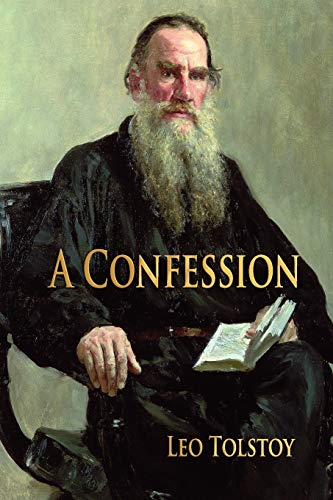

In one sentence
Tolstoy argues that intellectual explanations alone cannot make life worth living when death renders individual projects finite. Meaning becomes possible through a lived relation to the infinite—expressed for him as faith in God—and through participation in the moral life of ordinary people.
Overview
Written mainly in 1879–1880, circulated in Russia in 1882, and first published abroad in 1884, A Confession records Tolstoy’s midlife crisis rather than presenting a detached philosophical system. He begins with the collapse of his confidence in progress, art, science, and personal achievement. The central question keeps returning in practical forms: why live, act, or desire anything if death cancels everything? He considers four broad responses: ignorance, Epicurean enjoyment, escaping life, and continuing despite recognizing its absurdity. None satisfies him. His movement toward faith begins by observing that working people possess a practical answer to life’s suffering and death. The book ends not with doctrinal certainty but with an awakening into a God-centered, morally demanding way of living.
Core ideas
The crisis is existential, not merely emotional
Tolstoy describes depression, paralysis, and recurring thoughts of suicide, but frames them as consequences of a philosophical question: what can justify living when death is unavoidable? His privileged circumstances make the crisis sharper, because success fails to supply significance.
Finite answers cannot bear an infinite question
Science can describe causes and processes, while philosophy can expose contradictions; neither, in Tolstoy’s account, tells a person why life should be lived. Knowledge about the universe does not automatically become a reason for action.
He tests four ways of responding
Tolstoy surveys ignorance, pleasure, escape through suicide, and the strength of continuing despite recognizing life’s apparent meaninglessness. His own honesty prevents him from treating distraction or success as solutions.
Ordinary believers become epistemically important
Tolstoy turns toward peasants and working people whose faith is embedded in daily conduct, endurance, mutual obligation, and hope. Their lives suggest that meaning is not primarily an abstract conclusion but a way of inhabiting existence.
The conclusion is a conversion narrative
The work creates a before-and-after self: the earlier Tolstoy is trapped by reflective consciousness; the later self finds orientation through faith. Scholarship reads this as a deliberate transformation in both identity and authorship, not simply a neutral autobiography.
Tolstoy’s Christianity is selective and revisionary
The faith he reaches is not uncomplicated submission to institutional Orthodoxy. It develops into a personal, ethically focused Christianity that would shape his later religious and social writings. This makes the book a beginning of his religious thought, not its complete statement.
Practical takeaways
- Separate two questions: what explains life and what gives a person a reason to live. Tolstoy thinks confusing them produces sterile analysis.
- Test a worldview by the kind of life it produces—especially how it handles suffering, death, work, and obligations to others.
- Treat meaning as something practiced through commitments, not merely discovered as a proposition.
- Notice when achievement, pleasure, or intellectual sophistication are functioning as postponements of the mortality question.
- Use inherited traditions as candidates for investigation rather than accepting or rejecting them solely by reputation; Tolstoy finds their practical wisdom significant even while criticizing dogma.
- Remember that Tolstoy’s proposed answer depends on religious belief. Readers who reject theism may find his diagnosis more persuasive than his solution.
Caveats and counterpoints
- The book is retrospective and rhetorically shaped as a conversion account; it should not be read as an unedited clinical record of Tolstoy’s mental state.
- Tolstoy presents ‘science,’ ‘philosophy,’ and ‘religion’ in broad, sometimes polemical categories. His criticism targets the limits he experienced, not every form of those disciplines.
- His appeal to ordinary people risks idealizing their faith and underplaying the social, economic, and psychological conditions that shape belief.
- The ending does not resolve every theological or ethical problem. It establishes direction—faith expressed in life—more than a fully argued system.
- Publication history matters: the text was censored in Russia and appeared in Geneva in 1884; editions and translations may differ in title, arrangement, and wording.
Questions worth revisiting
- Is Tolstoy’s real discovery God, or the necessity of commitment beyond what detached reasoning can prove?
- Does a life need an objective cosmic meaning to be worth living?
- Are his four responses exhaustive, or do modern forms of meaning—relationships, creative work, political action—escape his classification?
- Can the practical wisdom he finds in religious communities be separated from their supernatural beliefs?
- Where does honest existential reflection end and depression begin—and can either be addressed by philosophy alone?
Return to this when…
Return when achievement feels unable to answer ‘why continue?’; when comparing existentialism with religious philosophy; or before reading Tolstoy’s later works such as The Gospel in Brief, What I Believe, and The Kingdom of God Is Within You. Read it as the record of a crisis moving toward faith, not as a neutral survey of possible meanings.
Highlights
Thus it happens that now, as formerly, the influence of early religious teaching, accepted merely on trust and upheld by authority, gradually fades away under the knowledge and practical experience of later life, which is opposed to all its principles, and that a man often believes for years that his early faith is still intact, while all the time not a particle of it remains in him.
The belief instilled from childhood, in me, as in so many others, gradually disappeared, but with this difference, that as from fifteen years of age I had begun to read philosophical works, I was conscious of my own disbelief. From the age of sixteen I ceased to pray, and ceased, from conviction, to attend the services of the church and to fast. I no longer accepted the faith of my childhood, but I had a vague belief in something, though I do not think I could exactly explain in what.
My life had come to a sudden stop. I was able to breathe, to eat, to drink, and to sleep. I could not, indeed, help doing so; but there was no real life in me. I had not a single wish to strive for the fulfilment of what I could feel to be reasonable. If I wished for anything, I knew beforehand that, were I to satisfy the wish, nothing would come of it, I should still be dissatisfied.
Illness and death would come (indeed they had come), if not today, then tomorrow, to those whom I loved, to myself, and nothing would remain but stench and worms. All my acts, whatever I did, would sooner or later be forgotten, and I myself am nowhere. Why, then, busy one’s self with anything? How could men see this, and live? It is possible to live only as long as life intoxicates us; as soon as we are sober again we see that it is all a delusion, and a stupid one! In this, indeed, there is nothing either ludicrous or amusing; it is only cruel and absurd.
If a man lives, he believes in something. If he did not believe that there was something to live for, he would not live. If he does not see and understand the unreality of the finite, he believes in the finite; if he sees that unreality, he must believe in the infinite. Without faith there is no life.
Again, I felt this to be a thing apart from me and from the world. This God melted, as ice melts, from before my eyes; again there was nothing left, again the source of life dried up. I fell once more into despair, and felt that I had nothing to do but to kill myself, while, worst of all, I felt also that I should never do it. I went through these changes of conviction and mood, not once, not twice, but hundreds of times – now joy and excitement, now despair from the knowledge of the impossibility of life.
References
- Confession (Leo Tolstoy)
- Work info: Confession - Christian Classics Ethereal Library
- A Confession
- Meaning of Life, The: Early Continental and Analytic Perspectives | Internet Encyclopedia of Philosophy
- en.wikisource.org
- Tolstoy’s Confession: What Am I? | Who, What Am I?: Tolstoy Struggles to Narrate the Self | Cornell Scholarship Online | Oxford Academic
- lancasterlawoffice.com
- ccel.org
- en.wikipedia.org
- en.wikipedia.org
- en.wikipedia.org
- en.wikipedia.org